Take the title literally! Although you might agree that Carl Barks' comic book stories were indeed colourful for their inventiveness and adventure, he also made stories in which a certain colour played an important - or even decisive - role. This is all the more impressive, because Barks drew all his stories in black and white, whereupon the publishing company added the colours at a later stage in the production. The choice of colours was decided solely by Western Publishing and Barks had no say in the matter. In the beginning, he gave very thorough directions about the colouring he wanted in the panels but they were not followed. So he resigned himself to the fact that he would not get what he wanted: If I asked for a yellow desert, you could be sure it turned out red, he once sighed during an interview.
Still, Barks made several stories in which a certain main colour was part of the overall motifs (not to mention the more diffuse, similar colours to be used in scorching yellow deserts, luscious green forests, alluring blue oceans), but in the stories chosen for this page you will see that he also dreamed up titles and plots in which specific colours or colour mixes were called for. Now it is up to you to check whether Western's original issues or the many reprints from other publishers actually have lived up to Barks' expectations...


TITLE COLOURS

  WDCS230 Black Wednesday - 1959

Synopsis:
Scrooge tells Donald that there is a curse on Duckburg because of some bad hair tonic he sold to the Chillyboot Indians. Donald tries to get the Indians to lift the curse.

  U$51 How Green was My Lettuce - 1964

Synopsis:
The Money Bin has been undermined by gophers so Scrooge's money has to be moved immediately. But how does one get past the cunning Beagle Boys?

Comments:
Undoubtedly, Barks chose the title Black Wednesday at random (not knowing that it would, in 1992, become a term for a terrible day in the history of the British Pound, when it was redrawn from the markets due to currency speculators), but the other title was carefully chosen as a pastiche of the 1941 film How Green was My Valley directed by John Ford.


SPECIFIC COLOURS

  WDCS182 'Johnny the Bull' - 1955

Synopsis:
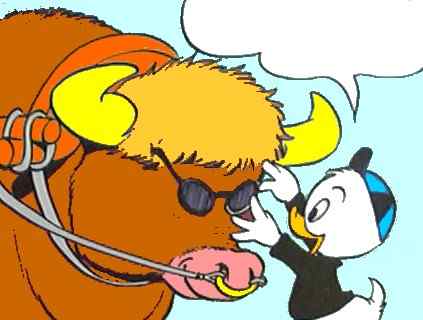
Donald wants to participate in the Farmers' Fair and he borrows Grandma Duck's gentle bull for the purpose. Eh, gentle???

  WDCS201 'The Dying Problem' - 1957

Synopsis:
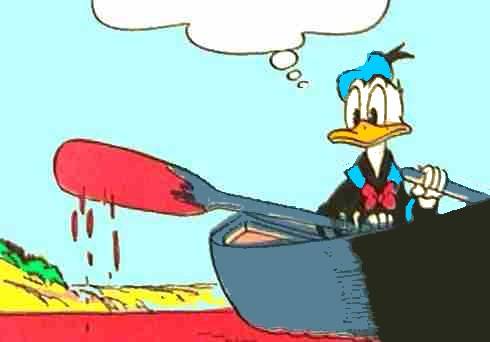
Donald is hired to pour bug powder into Duckburg's water reservoir but by accident he pours red dye into it instead. The result is somewhat different!

Comments:
A normal bull is said to be colourblind but Grandma's is extraordinarily special - it reacts violently to the colour Blue! Oddly enough it is not menacing to neither Donald's nor Dewey's blue caps when they are around! In the reservoir story the triggering colour is Red, and soon all Duckburgians have been in touch with the tainted water.


PRECISE COLOURS

  FC0422 The Gilded Man - 1952

Synopsis:
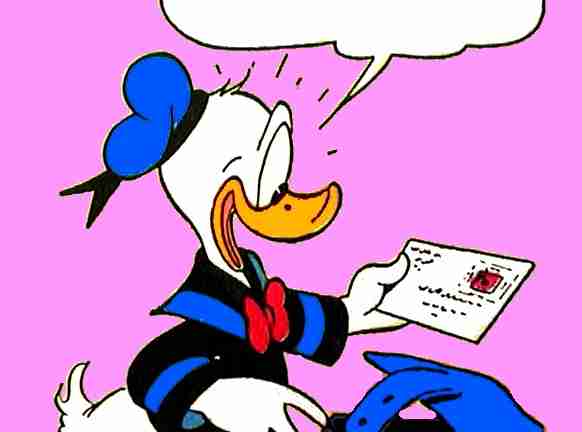
Donald travels to British Guiana in order to trace down a valuable stamp and he finds it on an undelivered letter. But it has to be delivered first...

  WDCS259 Jungle Bungle - 1962

Synopsis:
Donald is a skilled marksman with his bow and arrows and he is invited to Africa to shoot the pink-eyed rhinoceros with a tranquilizer arrow.

Comments:
The stamp is the extremely rare 1856 one-cent Magenta from British Guiana (now Guyana), and only one is known to exist today. In the many story issues the stamp has rarely been rendered in the real magenta colour. Besides, Barks made some important errors, if the stamp in the story is supposed to at least resemble the real one; it has an octagonal shape and is printed on magenta paper with black text, and is not, as Donald's stamp, rectangular and printed on white paper. In the rhino story Barks specifically called for the animal to be pink-eyed, but in many issues the eyes were more red than pink.


DIFFUSE COLOURS

  U$41 The Status Seeker - 1963

Synopsis:
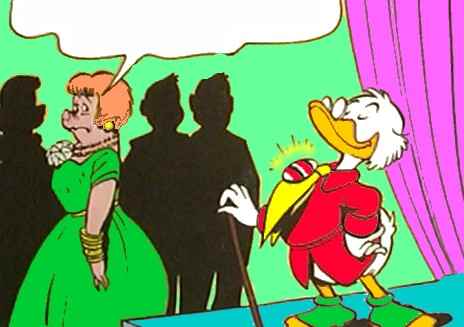
Scrooge longs to be part of the posh inner circles but he lacks the position. Then he remembers he owns the prestigious striped ruby. Where is it?

  U$54 The Billion Dollar Safari - 1964

Synopsis:
Scrooge's Zoo is failing and in order to get some more guests he will pay a billion dollars for a speckled elephant with a square trunk..
.

Comments:
The ruby is not only striped - it is candy-striped! Different publishers have had different approaches as for the gem's primary colour; you might expect a striped ruby to be dominantly red, but in other issues it has been white with red stripes! Barks never officially commented on the colour he preferred for his ruby and he did not comment on the speckles of his elephant, either! So different colouring artists have used their own initiative in the choosing of colour.


DIFFICULT COLOURS

  WDCS183 ' The Custard Gun' - 1955

Synopsis:
Donald wishes to go to the woods to shoot a turkey for dinner. He uses the custard gun that Gyro has invented. It can also shoot moose...

  U$31 All at Sea - 1960

Synopsis:
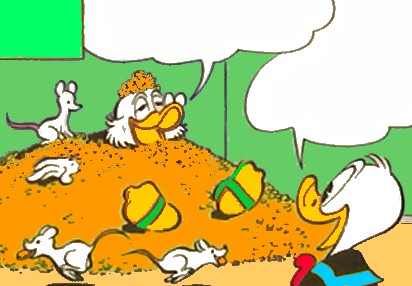
Scrooge sails home with a billion dollars in gold. But the Beagle Boys are following so he disguises the gold as corn. Now, beware of hungry rats!

Comments:
It is not possible to settle for one precise colour for custard as used in the custard gun story, because custard has a variety of tones depending on the mix of ingredients and the country of origin! So the egg yolkish tone chosen for this panel is as good as any. Rendering the colour of gold within a comic book's restricted colouring possibilities is even harder, because it is very difficult to make it look right. Furthermore, gold has a lot of tones depending on many factors (see more
HERE). Consequently, you will see that the colouring artists used many shades of gold in Barks' many stories featuring the precious metal.


MULTI-COLOURS

  WDCS155 'The Rainbow Heirs' - 1953

Synopsis:
Scrooge decides to find an heir for his vast fortune. He can choose either Donald, the nephews, or Gladstone.

  U$17 A Cold Bargain - 1957

Synopsis:
Scrooge buys all of the rare Bombastium in the world, but no one knows what it can be used for.

Comments:
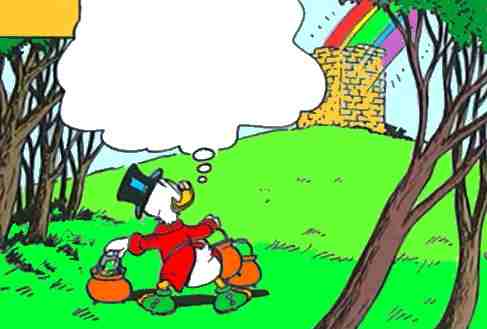
In the last two stories chosen for this page Barks used two objects that where to be rendered multi-coloured, but the choice of colours was very different. In the rainbow story the artists had no say; they were simply expected to colour the recurring rainbow correctly. The colours from the outside to the inside are red, orange, yellow, green, blue, indigo, and violet. In the other story the artists had free hands to choose whatever colours they preferred, because the ball of Bombastium had no Barks-named colour, and the texts required it to change colour the whole time anyway...


See more about Barks' use of colours HERE.


http://www.cbarks.dk/THECOLOURFULSTORIES.htm   Date 2007-08-26