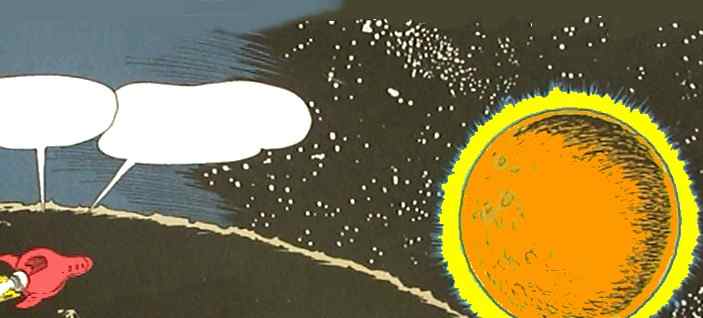
FC0456 Back to the Klondike
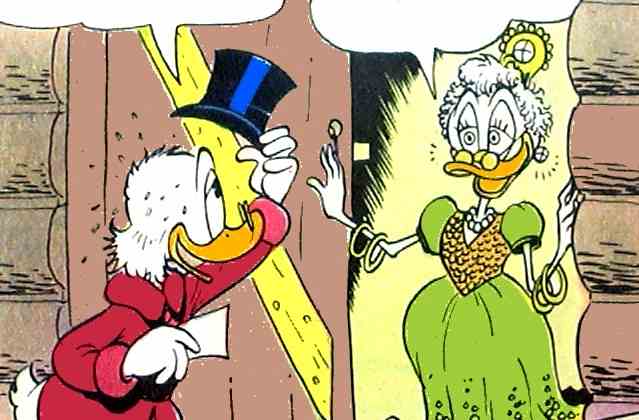
Scrooge suddenly
remembers that the saloon owner
Glittering Goldie some 50 years ago stole
his pouch containing the equivalent of a
thousand dollars from him. He never saw
it again, so she was forced to give
Scrooge an IOU or, as he snarled,
I tear this dive apart splinter by
splinter! Now he has come to collect:
At compound interest for fifty years
it would now amount to one billion
dollars! The size of the interest
rate would have been about 27.5% annually,
then...
|
|
|
U$31
All at Sea
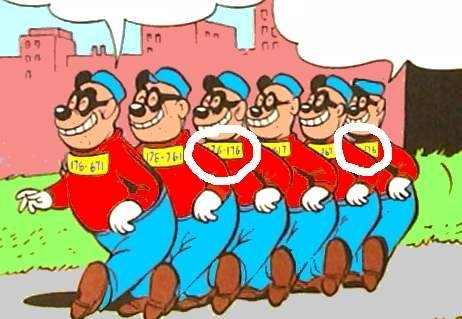
Barks invented the
Beagle boys and he added certain numbers
to their chests, which undoubtedly was
easier than supplying them with
individual names. By just using the
digits 1, 6, and 7 in a double function (for
example 176-176) he would end up with 36
combinations which should be sufficient
for his purpose.
Well, in this story 176-176 was portrayed
two times in the same panel(!) - but
maybe he was a split personality, anyway...
|
|
|
U$57 The Swamp of No Return
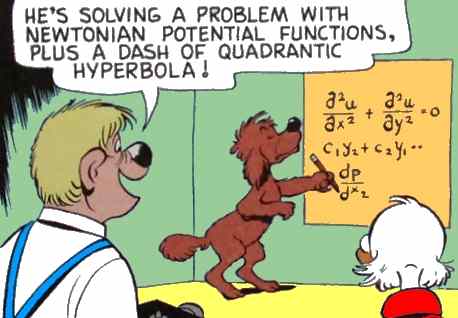
A scientist has
invented an apparatus that can completely
change the personality of any living
being. In this panel Barks offers these
impressive ingredients on differential
equations from the wonderful world of
mathematics.
NB.: Barks made a minor spelling error in
the dialogue: Quadrantic should read
Quadratic.
|
|
|
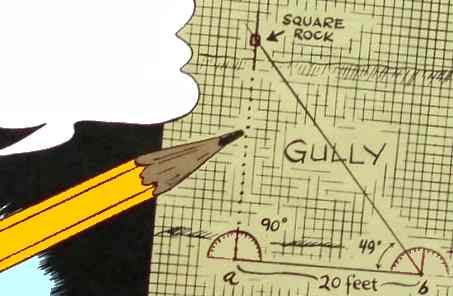
WDCS136 'Bridge Building'
The nephews (as
Junior Woodchucks) solve a simple
trigonometry problem (well, simple if you
know how, of course!). They have to
bridge a gully and for that end they have
to know the exact distance across the
stream. Using their JW protractor and
some calculations they soon figure out
that the distance to be 23 feet.
|
|
|
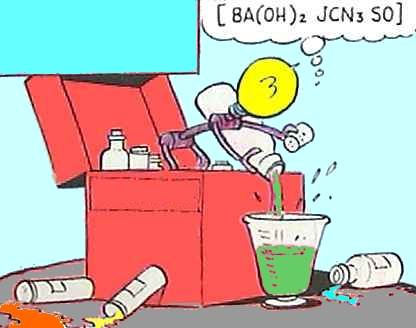
FC1095 The Bear Tamer
Little Helper invents a bear
repellent in order to subdue a ferocious
bear that almost finished off Gyro
Gearloose and Gladstone Gander. In the
panel Barks shows a chemistry formula:
I just stole that out of the
Encyclopedia Britannica. It was a big
article on chemistry with all different
chemical formulas, and it was written in
this gibberish - CO H and so on - and I
just looked at a whole string of those
things and looked at about the middle of
that. And I thought, Well, may be it's
harmless enough if I just take these
bunch of chemicals and sort of jumble
them up and stick them on a piece of
paper. Well, that is what I did, and it
turned out that it was a powerful
chemical formula.
Indeed it was! Inadvertently Barks
had come across a small part of a formula
that was considered a top military secret
of the USA at the time!
|
|
|
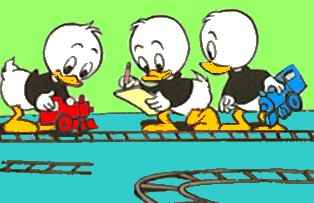
WDCS195 'Train Collision'
Barks presents us
with two calculus problems that are both
solved by the nephews. At first, they
play on the floor with their toy trains;
they try to figure out the precise speed
of two locomotives in order to prevent
them from colliding on the track. Later
on the gruesome reality sets in when a TV
announcer prompts people for help; a
runaway locomotive and The Limited, a
passenger train, are on collision course
and the rescue people need to know
exactly where the collision will take
place. He offers a number of details: The
Limited's speed uphill is 60 mph less ice
slippage of 8.64%! Headwinds of 50 mph
will be met for 12 miles below Blue
Canyon! At mile 23 the grade increases 4%
...
Information continues to pour out
enabling the nephews to calculate the
point of collision, the rescuers can
throw down rubber mattresses onto the
track, and lives are saved!
|
|
|
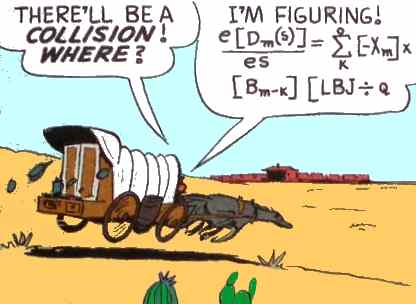
U$69 The Cattle King
The nephews succeed
in saving a high-speed train from
colliding with a trainload of explosives.
One of the nephews says: According to
the Junior Woodchucks' Guidebook's page
of differential equations in problematic
variables for diminishing ratios...
- His scared brother hurries him: Get
to the point! And the equation
follows as seen in the panel.
|
|
|
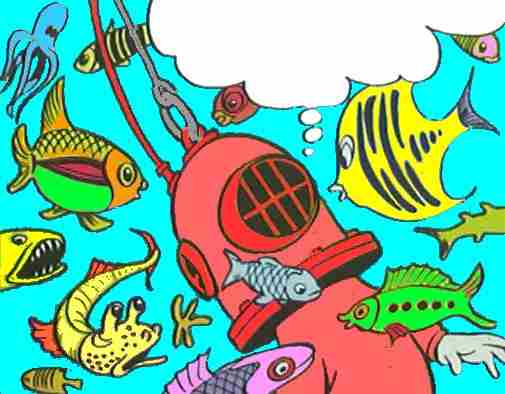
FC0495 'The Horseradish Story'
Scrooge points out
Donald's calculus error in a very
concrete and heavy-handed manner; he
batters poor Donald who misreads the
depth gauge as 3,000 fathoms. Scrooge -
who is diving at the time - immediately
realizes that this figure is equivalent
to three and a quarter mile, which cannot
be right. Donald soon learns that A
fathom is not an inch - it's six feet.
|
|
|
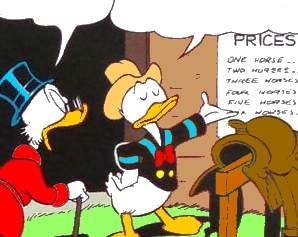
FC0422 The Gilded Man
Barks also presents
a Donald Duck one-pager in this comic
book in which Donald has a riding stable.
His price list proves to be a bit rash
which the visiting Scrooge immediately
discovers: One horse $1.00 per hour;
two horses 90 cents per hour each! Three
horses 80 cents per hour each! Four
horses 70...
Scrooge ponders the simple
mathematical problem and rents 11 horses
whereupon he rides off free of charge!
One can only wonder why he failed to rent
more horses. That way he could have
earned money on the deal...
|
|
|
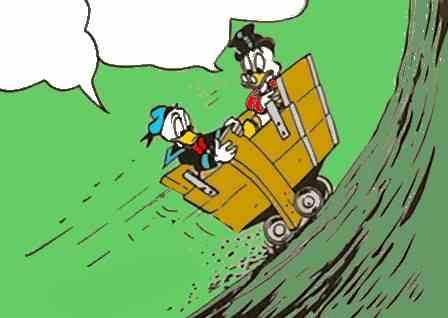
U$13 Land Beneath the Ground
Scrooge forces
Donald to accompany him underground by
presenting an old IOU of his: ...for
fifty cents you borrowed in 1950! At
compound interest that now amounts to 500
dollars! That constitutes a whopping
115% per year! Blackmail has always been
a powerful weapon....
Also, Scrooge has always swindled Donald
in their working relationships by giving
him less than starvation wages. Still,
Donald accepts the raw deals - he knows
that he is up against a magician in
mathematics!
|
|
|
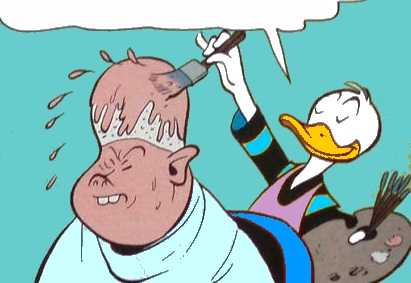
WDCS272 Spare that Hair
Donald is an expert
barber who takes on all sorts of requests.
One comes from an insecure young man who
wants to be an egghead in order to
impress his girlfriend. By simply
applying a huge build-up dome of plastic
foam and ivory enamel to the man's scalp
he completely changes personality:
All of a sudden I understand barycentric
calculus and the interpolation of
isoperimetric arcs! F(x) = dx = Dy
+ 2z!
|
|
|
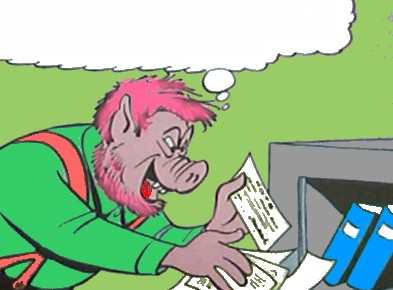
U$59 North of the Yukon
The sleezy
moneylender Soapy Slick finds an IOU from
Scrooge: Here it is - the IOU he gave
me in 1898! One hundred per cent interest
per month, compounded forever! That means
the sum doubled every month for sixty-seven
years! Whee! Billions! Trillions!
Uncountable fantasticatillions!
More precisely the total amount in
dollars after 67 years would be a mind-boggling
243-digit figure!
|
|
|