Carl Barks' declared aim with his stories - apart from the prosaic and understandable wish to earn a living by them - was to give his readers full value for their money. He did so by dreaming up incredibly inventive stories that are still fresh and appealing after so many decades, by rewriting and polishing the plots until he was content, and by drawing in a breathtaking style that was - and still is - the envy of many fellow artists.
Barks' stories can be read on several levels; you can read them just to enjoy the action, you can examine them for their technical qualities, and you can look for hidden or dual meanings of many sorts. As for the latter Barks always dismissed attempts to get certain messages across (which is not entirely true) but it was inevitable that he from time to time would comment on his perception of daily life as he saw it. Still, he was always very hesitant to dig too deep into controversial subjects. In his more facetted stories Barks acted as a wise and trusted guide and advisor - a Mentor.

NB.: This website carries hundreds of pages which mention examples of stories where Barks performed as educator and pedagogue in highly different fields.


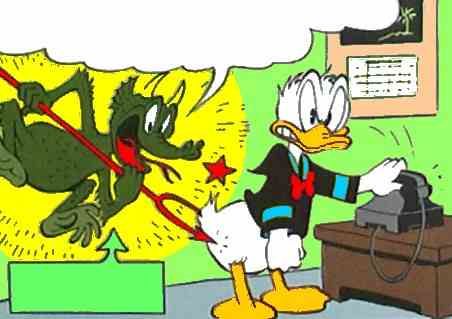
WDCS156 'The Master Rainmaker'

  Human frailties

Barks' stories take up the vast concept of human frailties in an unending stream. No wonder, because they are an unmistakable - and constant - part of our lives. Barks was a master in writing seemingly innocent stories where different frailties were displayed, often in such a clever manner that we might not realize it the first time. But they are there.
Examples:
In WDCS070 'Smugsnorkle Squatty' the main subject was snobbery: Why go for a common and happy dog, when you can buy a posh and haughty one with a pedigree? In WDCS092 'Pulpheart Clapperhead' Barks took an ironic and sarcastic look at professors filled with hot-air: In this case he took up free child upbringing. In WDCS095 'Fund Raising' Donald and Gladstone are bragging recklessly about their alleged riches: But they are not able to give Daisy a small contribution for her club. In WDCS147 'Blackmail' we experience Gladstone's most cynical and repelling side: He tramples poor Donald who is forced to obey his every beck and call. In WDCS156 'Master Rainmaker' we observe all-consuming jealousy: Donald recklessly risks the lives of many people in a blind attempt to get even with Gladstone.


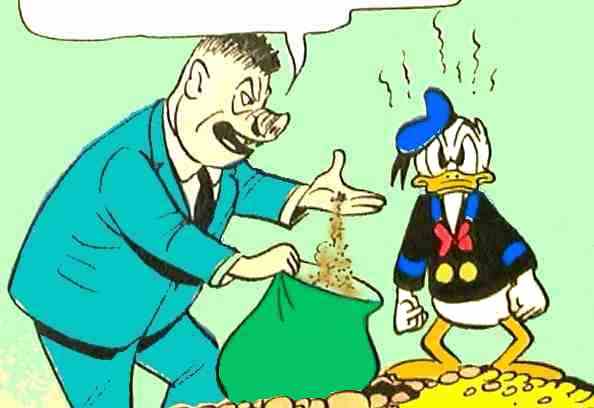
WDCS271
A Stone's Throw from Ghost Town

  Social realism

Barks gives us several stories that contain social realism. His messages are always plain to see, because they shine powerfully through the stories in question.
Examples: In FC0367 A Christmas for Shacktown we are introduced to a desolate part of Duckburg: The inhabitants are not able to make ends meet. In U$32 Clothes Make the Duck we are presented to a lot of poor vagabonds: But Barks makes sure that we see them as fellow beings.
In WDCS034 Good Deeds Barks is moralizing Donald who has no concern for others: The nephews talk him into helping people instead. In WDCS126 'Cyclone Money Crib' we are presented to a fable of how human nature works: No one wants to work as long as they have money to burn. In WDCS271 A Stone's Throw from Ghost Town Donald is expecting something for nothing: He is cheated in a business venture where everything seems to be rosy.


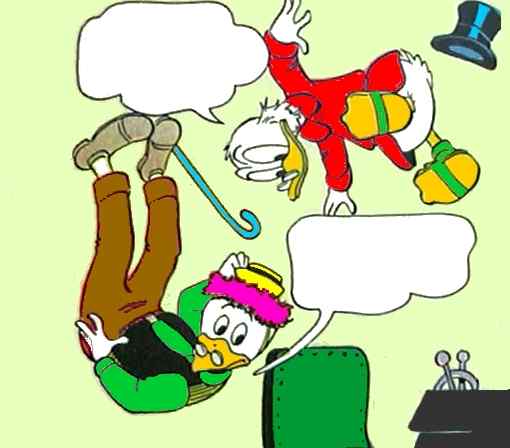
DBP 'Impenetrable Money Bin'

  Education

Barks would fairly often leave us more wiser after having read one of his stories due to the simple fact that we actually learned something worthwhile during the session. But he was never a serious schoolmaster; knowledge was sort of 'sneaked' in.
Examples: In DBP 'Impenetrable Money Bin' we get genuine information about space travel: Scrooge and Gyro experiences G-forces, gravitation, and weightlessness. In FC0029
The Mummy's Ring Barks takes us on a sightseeing tour of Egypt: We are presented to realistic renderings of Cairo, the Nile river, as well as ancient buildings. In WDCS189 'Backyard Trouble' we are given a lesson on how Mother Nature works: We receive serious pointers on the topic of environment represented in plants and animals. In WDCS199 'Bigger and Bigger' we are taught about comparative sizes: In another universe gnats might be as big as elephants. In WDCS264 Master Wrecker Donald shows us how to wreck buildings with the highest grade of competence: This is just one of many 'How to...' expert stories.


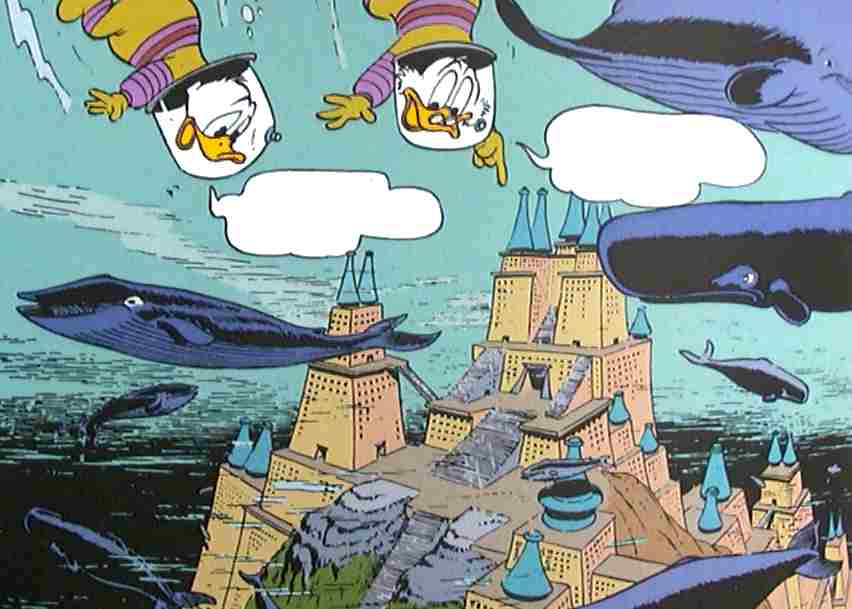
U$05 'Secret of Atlantis'

  Literature

Barks was an avid reader of books when he found the time, and many of his stories were triggered by plots, characters, or passages from different books. He would fabulate over the themes thus making the stories his own inventions but it is most often clear from where he got the initial ideas. It is fair to assume that many of Barks' readers would seek additional information about the initial topics after having read the stories.
Examples:
In U$05 'Secret of Atlantis' the ducks travel to the fabled island of Atlantis: The story of legendary sunken Atlantis has inspired countless more or less serious authors since its first mentioning by the Greek philosopher Plato. In U$10 The Fabulous Philosophers' Stone Scrooge has found a lead to a stone that can change everything it touches to gold: Barks used the medieval myth of the alchemists' stone with the desirable ability as well as the mythological Minotaur in the labyrinth of Crete as ingredients in his story. In U$26 Krankenstein Gyro the inventor is inspired to create life: Barks had the British author Mary Shelley's novel about Dr. Frankenstein and his monster in mind when he dreamed up his comic book version about creating life from dead objects. In U$34 Mythic Mystery the ducks travel to a mythological place named Valhalla: We are introduced to a great many gods and goddesses and learn of their different traits. In WDCS110 'The Goldilocks Story' the nephews have decided to play Goldilocks and the Three Bears: Barks' plot is based loosely on an old German folk tale collected by the brothers Grimm who collected more than 200 folk tales.


Keno Don Hugo Rosa and Barks

  Fellow artists

Ever since Barks and his work became known within the comic book industry many fellow duck artists have admitted to be deeply indebted to him. Most of them grew up with his stories and they left lasting imprints in the future artists' minds.
Examples: Patrick Block (USA) learned to
read via Barks' classic duck stories and now - as a duck artist - he is focused on making interesting stories as efficiently as Barks did. Daniel Branca (Argentina/Spain) made stories heavily influenced by Barks' style. Keno Don Hugo Rosa (USA) grew up with Barks' comic book stories and is now seen by many as the best Barks successor. Marco Rota (Italy) has Barks as his role model; as Barks did he starts off with a basic idea, writes a synopsis supplemented by storyboard drawings, and then polishes the story. Victor Arriagada Rios (called Vicar) (Chile) was Barks' own choice as the artist who came the closest to his own drawing style. Since then Vicar has had a photo of his ideal in front of him at the drawing desk, and he salutes it every day!


http://www.cbarks.dk/THEMENTOR.htm   Date 2006-11-17