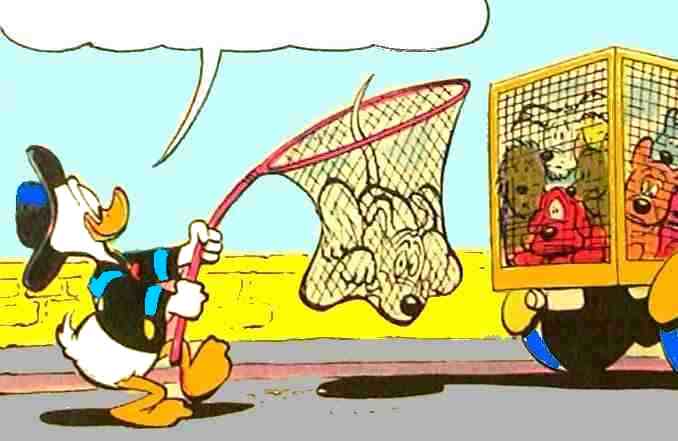
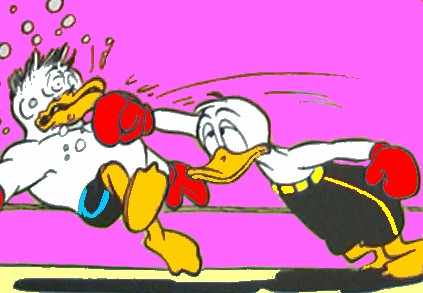
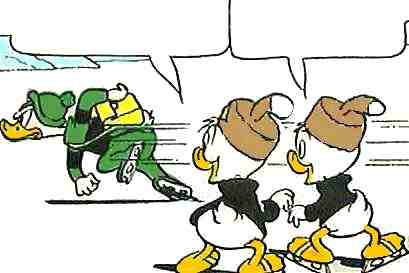
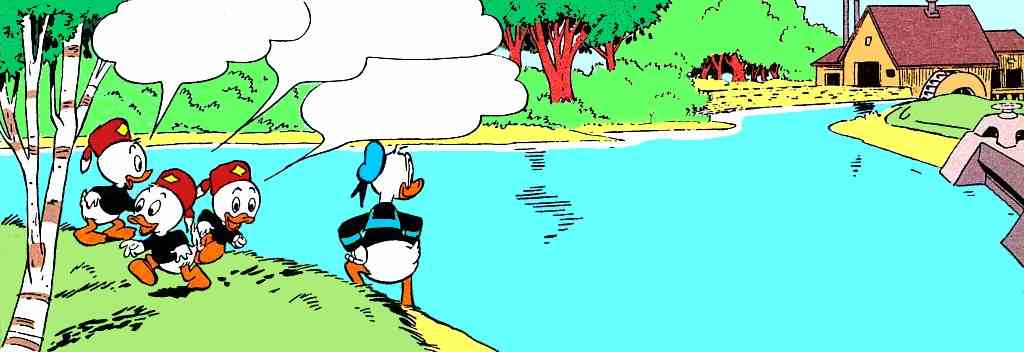
Over the years Carl Barks developed his Disney comic book stories featuring the Duck family (Donald and the nephews Huey, Dewey, Louie) from the mostly being blazing clashes of the kind he was taught during his previous cartoon film career, only to slowly change the stories into more complex and insightful opuses, in which readers of all ages could enjoy Barks' stunning storylines, graphics, and inventiveness - ingredients that still keep them very much alive today!

At some point Barks introduced a whole new concept. He had rather quickly developed the nephews into reasonable and sensible youngsters (contrary to their uncle who often went in the other direction!), but now he added their membership of the boy scout organisation Junior Woodchucks, which turned out to be a stroke of genius, because the Duck family became blessed with a series of new ideas. Barks realized that he to some degree should present stories in which the tables were turned, meaning that the nephews should act as responsible 'adults' while Donald played the role of a somewhat thoughtless uncle with little regard of the consequences of his actions. The 10-pager story on this page is a fine example of all these ingredients melded together. It came in WDCS132 'Boonehead Donald' from 1951. This is the story.


SYNOPSIS

WDCS132 'Boonehead Donald' - 1951

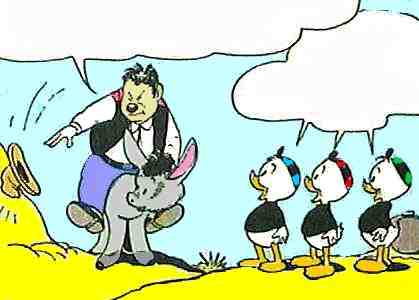
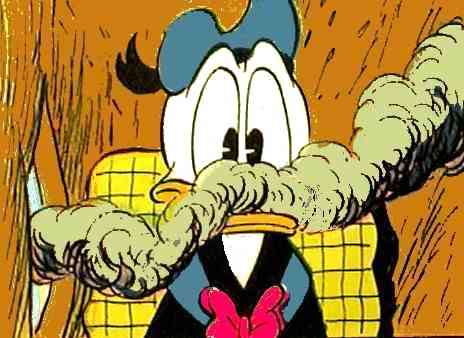
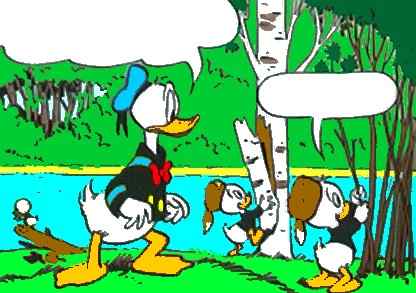
The nephews are off to the local millpond to try for separate merit badges in the Junior Woodchucks organisation but unfortunately Donald decides to help them. This means that the nephews all flunk despite Donald's honest attempts. They would rather be left alone because their uncle's knowledge about basic scout merits seems to be based on his lacking - to say the least - abilities from his own boy scout days in the little known Boonehead organisation.
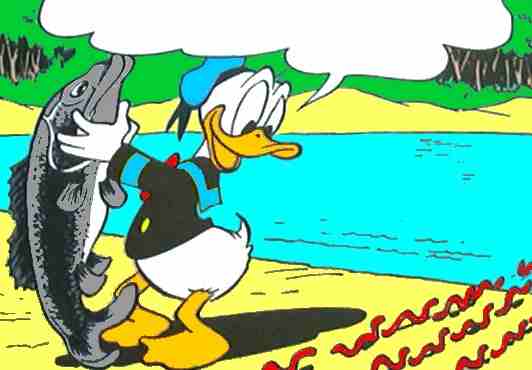
But Donald's unsubstantiated bragging about former merits accompanied by the building of substandard contraptions prove disastrous, and in the end the common sensed nephews have to rescue their uncle.


COMMENTS


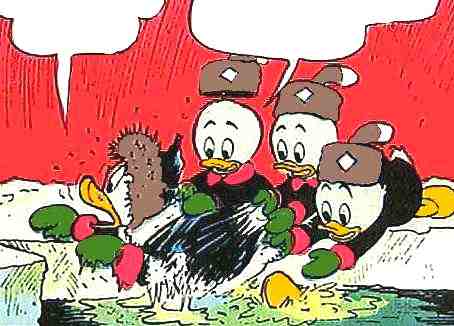
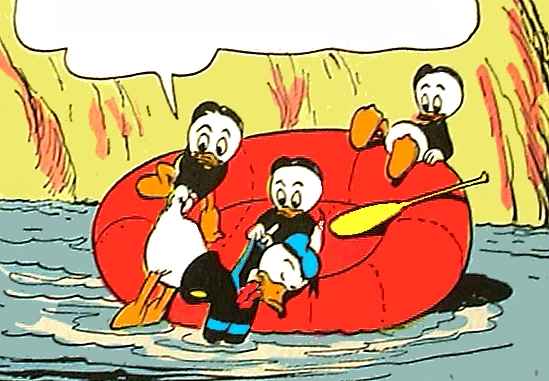
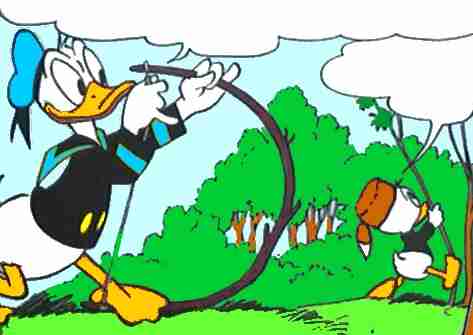
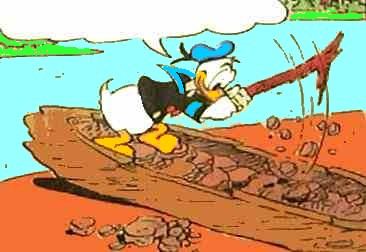
It is quite rare to experience the nephews as individuals, but in this story their roles are clearly defined: Huey is an archer, Dewey makes a canoe, and Louie is a lifesaver.
This is one of the very few stories in which Barks actually distinguished between the nephews (by name and by task) instead of 'just' treating them as one organism.


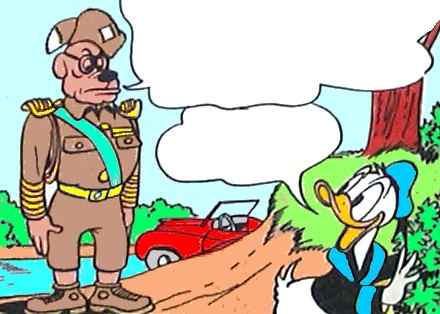
Over the years Barks placed the Junior Woodchucks leaders in two distinct categories; during his active comic book career they were all stern and dog-faced individuals, but after his official retirement - when he made numerous HDL stories - they all became slightly dimwitted looking geese characters (see examples HERE)...


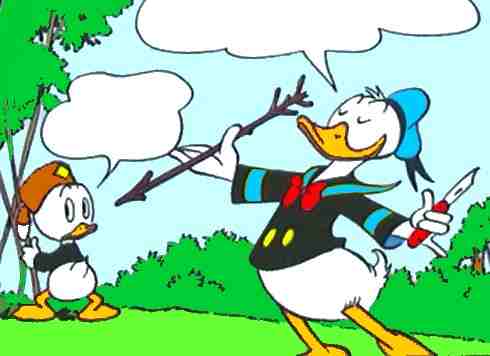
From time to time we are presented to the fact that the Duck family's sweaters and blouses have (hidden) pockets (see more HERE). In this story Donald suddenly produces a large pocketknife that is able to cut even thick branches.

The nephews undergo a strange form of metamorphosis in many of the stories. In most of them they are carefree, lively and bratty, but as soon as they take on their role as Junior Woodchucks they change personalities completely into being both serious, thoughtful and responsible.


It would seem that Duckburg is amply provided with water locations. Examples other than this story's millpond: A reservoir in WDCS201 'The Powerful Dye', a remote dam in FC0386 Only a Poor Old Man, and an unused storage facility in WDCS155 'The Rainbow Heirs'.
Furthermore, there are a lot of lakes of which some are named (see more HERE).


Donald's bragging is often triggered by his wish to show the nephews that he masters all sorts of different skills. But it always becomes strikingly apparent that he is no match to his nephews who really possess the required skills in certain situations.
Examples: Saving Donald from drowning in a freezing river in WDCS066 'The Ice Fisherman', outsmarting and catching clever smugglers in WDCS197 'Border Patrolman', and bringing the whole family safely home from a white water boat journey in WDCS228 'The Watchful Parent'.


Donald fully mastered the fine art of self-victimization, i.e. bringing himself to rotten situations that could easily have been avoided. Examples besides this story:
In FC0256 Luck of the North Donald got tired of Gladstone Gander's never-ending luck so he sent him up north with a fake treasure map, in WDCS137 'The Screaming Cowboy' he insisted on playing his own song with still more dire consequences, and in WDCS161 'The Fix-It Shop' he was overpowered by his own lack of practical skills.


Sometimes Donald is equipped with an Ego that defies normal common sense. He likes to brag about his self-appointed know-it-all abilities, which always backfire. The many so-called Expert stories are shining examples (see a small selection of them HERE).


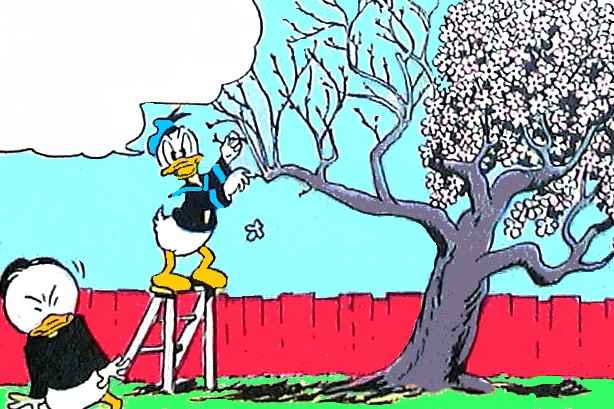
Donald tries to convince his nephews that he used to be a better boy scout than they are now, but his lack of basic botanical knowledge soon cuts him down. This also happened in other stories. Examples:
Attempting
to beautify his backyard garden in WDCS189 'Backyard Garden', trying to grow prize-winning apples in WDCS205 'Garden Rookie', and wanting to increase his knowledge of the most common flowers in WDCS214 'Deflowered Donald'.

Barks made a fine play on words when he named Donald's former scout organisation The Booneheads thus making us (and the nephews!) think of the slang term Bonehead that means Stupid. But Donald vigorously insists that the organisation was named after the famous American pioneer, explorer, and frontiersman Daniel Boone (1734-1820), because, as he shouts, 'we had heads like Daniel Boone' (!?)...
It was certainly not the only time Barks enjoyed presenting clever and subtle puns. The most overlooked example might be the title for U$34 Mythtic Mystery, in which the first word even by seasoned fans is perceived as Mythic instead of a cleverly constructed amalgamation of the two words Mythic and Mystic...


THE TASKS


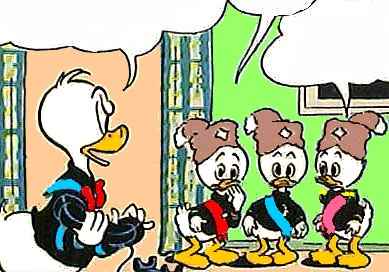
In order to obtain their merit badges the nephews emerge as follows: General Huey must make a bow and arrow for his badge in archery, General Dewey must make a canoe for his badge in Indian crafts, and General Louie must train for his badge in lifesaving. But Donald interferes by bragging to have the better background, and so the day of badging becomes a day of bashing - for Donald.

He was once a scout in the Boonehead organization, and he is sure that his advice is solid and sound. So, in order to help his nephews out, he constructs a bow and arrow (that cannot shoot) and a canoe (that cannot hold water). Confusion follows when he secretly exchanges his mediocre constructions for the nephews' solid and sound ones...


THE RANKS


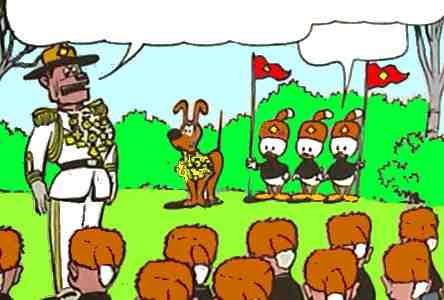
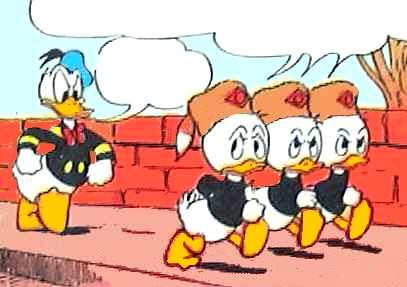
Normally, the nephews are sensible and helpful boys doing sensible and helpful deeds, and this is also true - maybe even more so - when they act as members of the Junior Woodchucks. But there is a distinct difference; during their time in the organisation they often dress in highly elaborate uniforms thus showing off a fetishistic side of themselves. Because there is no doubt that they simply adore dressing up. As for the organisation's inventive, unending, and colourful titles you can see a listing HERE.
In the present story no less than 4 titles are mentioned: The nephews start off as Five Star Generals, they are then on the brink of being demoted to Four-Star Generals, but wind up as Ten-Star Generals.
Their local commander presents himself as the Exalted Grand Marshal of Duckburg Burrow Number 13(!), but Donald disrespectfully refers to him as The Exalted Big Brass and The Grand Exalted Big Cheese...

As for Donald's membership in the Booneheads it might be fair to perceive that he stayed in the organisation for such a limited time that he never received any form of title or accolade...


THE PAYMENT


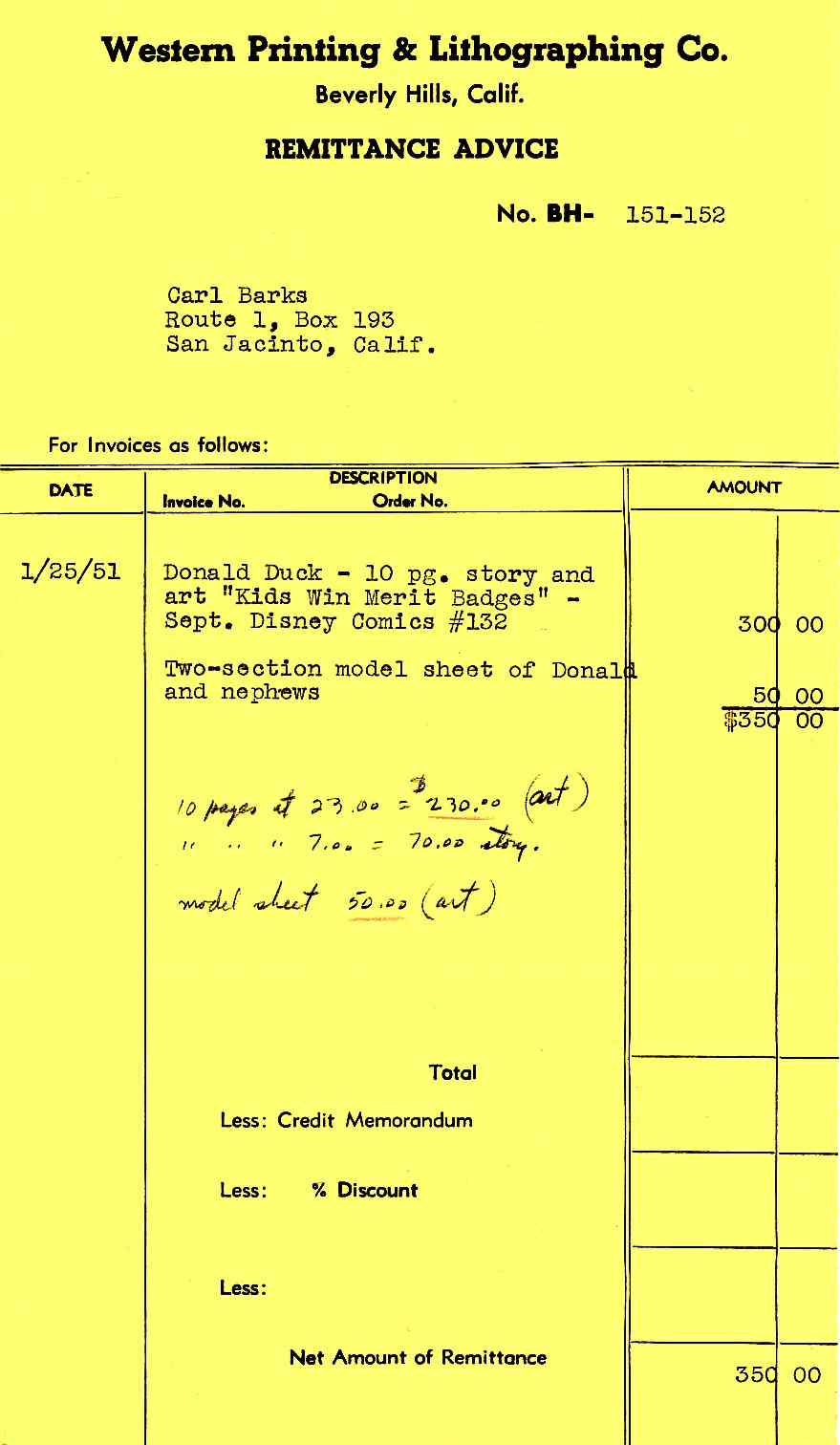
Barks always booked the payments he received from his employer Western Publishing, and he also kept the bulk of his receipts from same. Some of them are very interesting to browse through but most of them are merely contemporary status reports. The original receipt (Western operated with the term Remittance Advice) listed for this story is not special except for a few points:

A: Western would often give the stories unofficial titles along with the series' issue numbers. In this case it was dubbed Kids Win Merit Badges. Sometimes Barks would scribble down a work title of his own in order to more easily recall the story.

B:  He normally wrote down the breakdown of the received amount. Here it shows the standard payment for art (23 dollars per page) and for story (7 dollars per page).

C: From the following story Western gave Barks a 3.50 dollars increase per story page bringing the total for a standard 10-pager to 335 dollars (25 plus 8.50 dollars). This policy took effect retroactively from this story.

D: Western had asked Barks to furnish them with a couple of modelsheets of the Duck family, and Barks was eager to oblige as this would make it easier for other artists to follow his lead as it were. You can browse copies of the two sheets HERE.


BONUS

THE MEDDLINGS

Donald was active in several more stories featuring the nephews as Junior Woodchucks. Here are some examples of Donald's interference making him both a positive and a negative role model.


WDCS125
Helping Bornworthy in a JW test

WDCS136
Helping with a turkey raffle

WDCS158
Moving a beehive

WDCS181
Trying to help at bridge building

WDCS213
Trying to lure the JW hound

WDCS221
Trying to solve a puzzle

WDCS227
Asked to hide out in the woods

WDCS232
Helping in a JW test

WDCS238
Taking on a job as dog-sitter

WDCS253
Hunting down Troop Two's hound

WDCS282
Helping the Duckburg JW branch

WDCS294
Trying to donate a prize


 http://www.cbarks.dk/THEBOONEHEADSTORY.htm

  Date 2018-06-10