
When Carl
Barks left his job at the Walt Disney Company's cartoon shorts department to work for Western Publishing as a creator of comic book stories, it
was to be expected - as well as fairly logical - that he carried over much of his
knowledge of cartoon work into his story panels. But the two media are basically
quite different (cartoons work with sound, speech, and the impression of real movement, while
stories work with dialogue, complex plotlines, and stimulating knowledge based
information), and it took Barks a while to come to grips with the new type of
artwork. This new way of constructing stories was partly preceded by many
stories, in which much action and little dialogue were triggering elements, just
as if the characters were still in their diffuse cartoon environments.
But Barks would slowly 'convert' to more complex and eventful stories, partly
due to a conversation he had with the Mickey Mouse artist Floyd Gottfredson:
You could draw just so much violent action in a comic book before it began to
get tiresome. I think Floyd Gottfredson put his finger on it one time when I was
talking to him, sometime in the nineteen-forties. I'd gone to the studio for
something. He said, 'In the strip, the reader can hold it up, and he looks at it
for a long, long time, but when it's on the screen, he sees it for a
twenty-fourth of a second, and it's gone. There's no chance for him to look at
it too long.' I remembered what he had told me, and I toned down my action a
little bit after having talked with him.
Below you are
presented to a small selection of 10-pager stories - in chronological order -
from the early years when Barks was still influenced by his cartoon work (you
can browse a few specific examples
HERE).
 |
|
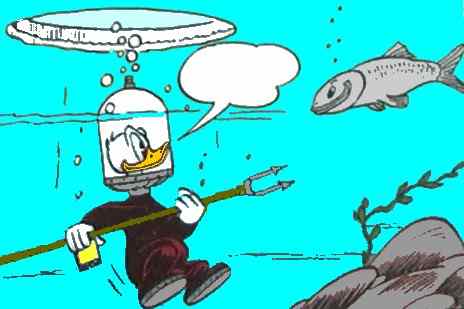
WDCS033
'The Lifeguard'
- 1943 Synopsis:
Donald Duck
is a lifeguard with a special attitude towards
sharks - and ladies!
Comments:
This story has certain similarities with the cartoon Sea
Scouts from 1939, for which Barks wrote the script
containing a few shark gags that he re-used in the story.
Extra: Barks spiced up the goings-on by introducing a
highly sexy duck lady, but her busty appearance was censored...
|
|
 |
|
WDCS038
Good Neighbors
- 1943 Synopsis:
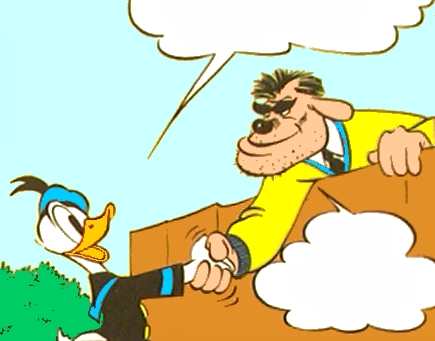
Donald and J. Jones bury the hatchet but it is of
course just a matter of time before things are
back to (ab)normal.
Comments:
In the cartoons Donald was often quarrelling and even
fighting with diverse persons. Only one of these was recurring,
namely Black Pete, whom Barks introduced as a formidable
adversary to Donald in several cartoons. In the stories he soon
needed a recurring neighbour to joust with, but Pete was not a
preferred choice as he was mostly found in the stories from the
Mouse universe.
So Barks invented Jones as Donald's unforgiving adversary,
and, mostly, he arranged their disputes in such a way, that it
was not always clear who was the instigator.
|
|
 |
|
WDCS040
Snowfun
- 1944 Synopsis:
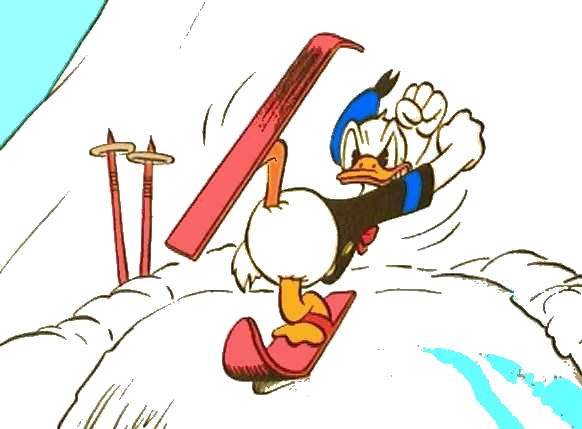
Donald wants to show his nephews what a great ski
jumper he is, so he prepares for a jump from a
mountain top...
Comments:
This story would have been perfect for a cartoon with its
two main ingredients; Donald boasts to his nephews of his
alleged skills as a skier, and he is then forced to prove
himself, a task that, of course, goes terribly wrong.
In a later story, WDCS173 'The New Year's Resolutions'
from 1955, Barks further developed Donald's lack of skills by
making him look extremely foolish on another ski slope.
|
|
 |
|
WDCS041
The Iron Pants
- 1944 Synopsis:
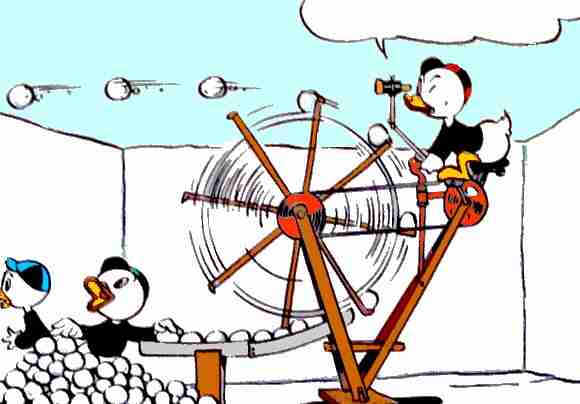
Donald brags that he knows all the old snowball tricks so
the nephews cannot resist challenging
him...
Comments:
Of course, the nephews have the upper hand throughout the
ensuing battle, because of their more intelligent approaches,
where Donald just blurts on. The cartoony action story has
certain similarities with Barks' cartoon Donald's Snow Fight
from 1942, in which he served as story director.
|
|
 |
|
WDCS045
Rival Boatmen
- 1944 Synopsis:
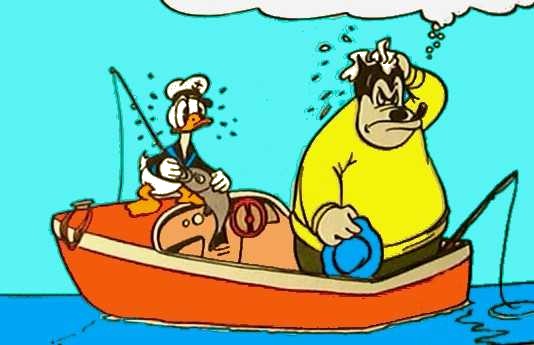
Donald and the nephews are running competing boat
rentals for fishermen. Donald sabotages their
boat in order to get the customer...
Comments:
One of Barks' recurring themes, especially in the early
years, was Donald's continuous quarrels with his nephews. Most
of them ended with Donald as the loser, and this story is no
exception. Apparently, Barks found the specific topic of ice
boat rental so interesting that he made a similar story known as
WDCS186 'Duelling Ice Taxis' from 1956.
Observe that Barks actually did use Black Pete as Donald's
adversary, although he was named J.P. Diamondtubs in the story.
|
|
 |
|
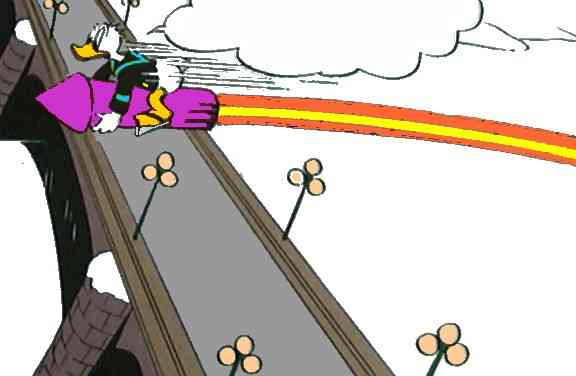
WDCS054
'Skate Race'
- 1945 Synopsis:
Donald
and the nephews decide to race to Pumpkinburg on
skates. But Donald stoops to cheating...
Comments:
This time Donald is clearly in the wrong in his dealings
with the nephews, as he first decides to taunt them with their
fine ice skating skills, and then decides to cheat in order to
beat them in a race. The contained, frantic actions - that also
involve a mindless trip on a lit giant firecracker -
would have been perfect material for a cartoon.
|
|
 |
|
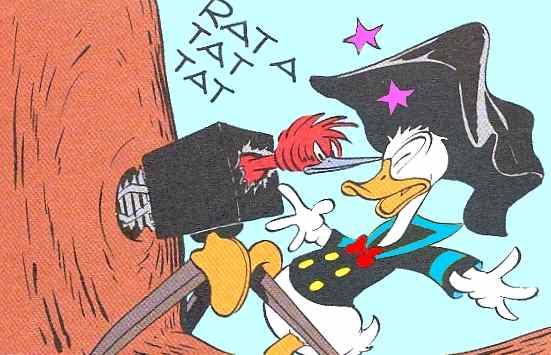
WDCS057
'The Elusive Woodpecker'
- 1945 Synopsis:
Donald
can earn a thousand dollars by photographing the
elusive Iron-Billed Woodpecker. How hard can that
be ...?
Comments:
It
may well be that Barks borrowed parts of his plotline from
contemporary cartoons such as the Aracuan bird in the Disney feature
film The Three Caballeros from 1944 and made them his own
- usually with a twist.
But this story is also an example of the
turning of tables, because the 1947 Disney cartoon Clown of the
Jungle contains several scenes that must have been taken
from Barks' fast paced story in which Donald tries to photograph
an uninterested yet somewhat vindictive special woodpecker for
money.
|
|
 |
|
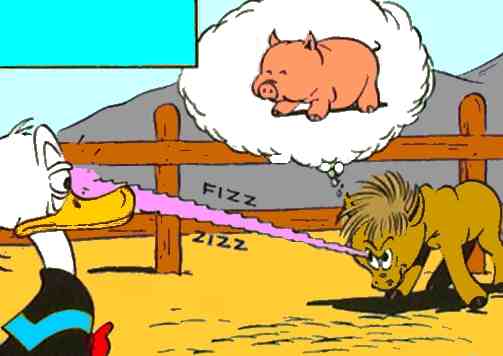
WDCS059
'Colt Taming'
- 1945 Synopsis:
Donald
brags to the nephews about his abilities to tame
a wild colt. He is soon put to the test...
Comments:
In several of the early stories Donald brags endlessly to
his nephews of alleged, former achievements without usually
having any conception of what he is getting himself into, when
the nephews later dare him.
After having used brute force to
subdue the animal, Donald tries to tame the wild horse by using
hypnosis, but his willpower is not nearly as strong as that of
his adversary.
|
|
 |
|
WDCS066
'The Ice Fishing Expert'
- 1946 Synopsis:
Donald
claims to be an expert on ice fishing but he
immediately gets into trouble with a large fish.
Perhaps dynamite is the solution?
Comments:
Again Donald takes on the role of an 'expert'. Despite good
intentions and basically fine decisions he manages to blunder
himself through a series of mishaps in an attempt to catch an
especially sly and elusive fish.
|
|
 |
|
WDCS079
'The Ruined Picnic' - 1947 Synopsis:
Donald
and Daisy go out for a picnic and the nephews
want to join them instead of going to school.
But the answer is 'No!' so they decide to ruin
the picnic instead!
Comments:
Although the nephews were usually portrayed as brats in the
cartoons, it is quite rare for us to experience them as culprits
towards Donald. And in this story they really go overboard in an
orgy of destructive methods of ruining Donald's and Daisy's day. But in the end the reckless brats fall into
one of their own traps and
justice is served...
|
|
http://www.cbarks.dk/THECARTOONYSTORIES.htm
|
|
Date 2015-11-09 |
