Carl Barks was very careful about the flow in his Disney comic book stories, a skill he learned during the cartoon years when he was an employee at the Disney Company. There it was important not to incorporate scenes that had little bearing on the plotlines, as they would only fill up space and bar more relevant ideas in the limited time available in a typical short cartoon. Barks was told to always move the action forward and to avoid unnecessary scenes, which were good and solid ballast, when he would later embark on his numerous comic book stories.
Most often Barks had more comic book material than he needed, which in turn forced him to delete perfectly good ideas. But on rare occasions it seems likely that he had the opposite problem; lack of material to fill a story. His solution would then be to add panels or whole sequences
which, in reality, had no other purpose than to serve as fillers, i.e. they could easily be omitted without them having any influence on the plot! Below you are presented to examples of Barks' fillers shown in chronological order.

NB.: In order to get the full benefit and understanding of the chosen examples you need to have the individual stories at hand thus enabling you to see the filler sequences and their surrounding panels as a continuous entity.

Disclaimer: A page containing examples of unnecessary filler panels will always be rather subjective, and the choices would be debatable. As the saying goes: One man's rubbish is another man's treasure, meaning that specific panels and scenes in a given Barks story may well be considered and judged differently by individual readers.


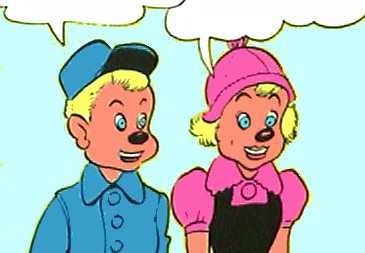
WDCS160 'The Christmas Camel'


U$09 The Lemming with the Locket


WDCS233 Knights of the Flying Sleds


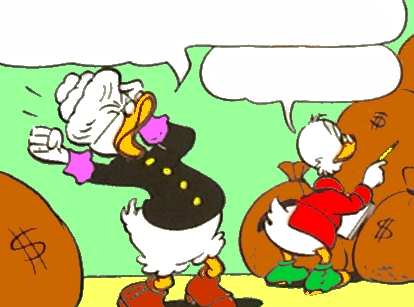
U$32 That's No Fable!


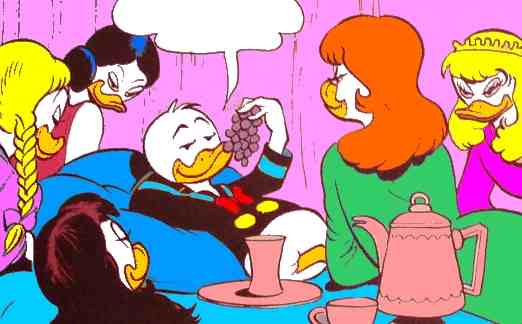
U$34 Mythic Mystery


WDCS262 Way Out Yonder

WDCS048 'The Putty Story' - 1944
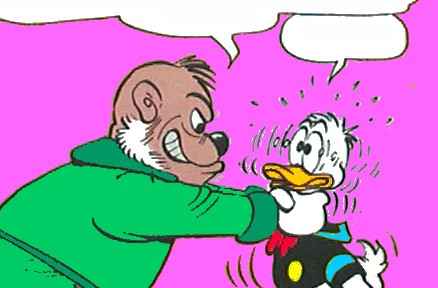
In this slapstick story Donald and neighbour Jones are physically fighting over a can of putty. The story only takes off after two pages of rather lengthy allegations that leave the reader none the wiser.

WDCS053 'Heading for Acapulco' - 1945
The Ducks' first cargo on their tramp steamer are boxes of bubble bath soap. That particular part of the story takes up 2½ pages which seems far too long for such a small event. Most of the rest of the story concentrates on the family's quarrel with a whale, which might also be stretching a fine main idea a little too much.

WDCS160 'The Christmas Camel' - 1954
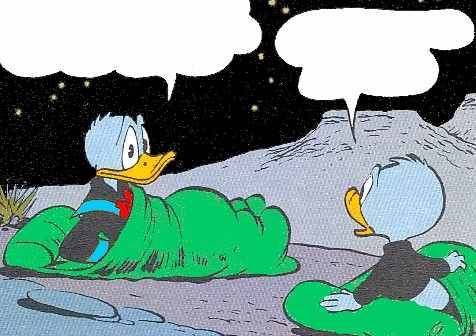
Donald's camel has been sprayed with fluorescent paint which becomes apparent throughout the entire page 8 of the story. The scene could easily have been cut to fewer panels.

WDCS169 'Playing Hooky' - 1954
Donald is trying to catch up with the nephews who are on the run in order not to go to school. In the story you may well skip page 2 with the nephews debating and demonstrating escape plans without missing anything important.

U$09 The Lemming with the Locket  - 1955
Several of the panels taking place in Norway can be deleted without any real impact on the story's flow.

WDCS204 'A Nosy Job' - 1957
An important aspect of a story is that the presence of one or more characters is not only justified but also brings the plot forward thus adding an extra layer. Barks was, of course, very aware of this technical issue, but a few times he sinned against the unwritten rules.
In this story Daisy was guest starring with nothing much to do but to listen to Donald. WDCS146 'Omelet' is another example.

WDCS233 Knights of the Flying Sleds - 1960
Page 1 and 2 are filled with the Duck family's neighbour's troubles caused by a small but escalating accident. The stretched scene itself has little bearing on the plotline and the flow of the story.

U$32 That's No Fable! - 1961
In two stories Barks let Grandma be a tiny and dispensable part of the plotlines (just as Daisy was in a few stories). In both of them she is merely serving as a listener at the start and in the end (U$GTD 'The Fantastic River Race' is the other one).

U$34 Mythic Mystery  - 1961
Donald's presence was really not required! He had nothing to do, and he did not contribute to the plot. All the actions were taken care of by Scrooge and partly the nephews, while Donald rests.
This was also the case in FC0328 In Old California!, in which Donald was mostly dallying around as an observer to the goings on. The minimum of action he was involved in could easily have been carried out by his nephews.

WDCS262 Way Out Yonder - 1962
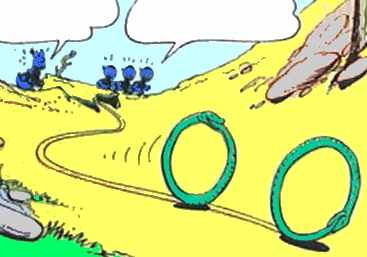
Page 8 is solely taken up by a series of highly mysterious tracks which the Ducks curiously follow only to discover they are made by a pair of hoop snakes. The scene has no bearing on the plotline.


EXTRA

...
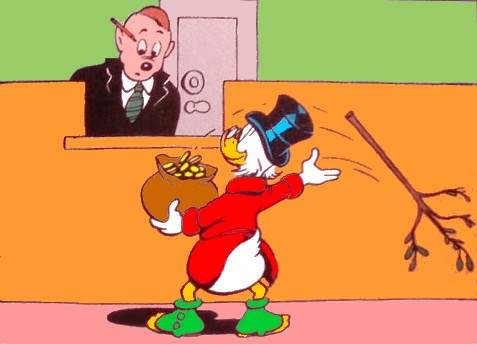
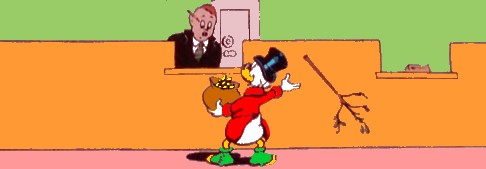
U$33 Tree Trick: The original art and the published art

All of Barks' publisher Western's comic books had an area where they placed the so-called Indicia, i.e. technical facts about the issue, the publisher, the printer, and so on. In most of the books the indicia was placed at the bottom of page 3, which was where Barks had his first page of a 10-pager Donald Duck or a longer adventure story starring Scrooge. Barks knew this and, consequently, his start pages were always 3 rows high instead of the normal 4 rows leaving ample space for the indicia.
But sometimes Western would place the indicia on page 2 (the front cover's inner page). Here you would typically find a one-pager, and this presented a slight problem, because Barks usually drew his one-pagers in 4 rows. Quite understandable, because he would never know beforehand where a certain page would show up in a particular comic book. So when Western occasionally (such as in U$23) decided to place a Barks one-pager on page 2 along with their indicia, they had to disfigure his art slightly.

It is plausible that Barks were told that some of his one-pagers would be cut by one panel, i.e. consist of 7 panels instead of 8, leaving room for Dell's Pledge for Parents that was placed in all of the comic books. But sometimes he miscalculated; in the one-pager Tree Trick from U$33 Western did not use the extra space. Instead they stretched the artwork so that it filled two panels...


 http://www.cbarks.dk/THEFILLERS.htm

  Date 2016-01-10