When Carl Barks was asked how he would like to be remembered he would respond: As a Storyteller! And that was exactly what he was! He could tell stories like no one else could, because he was able to put so many surprising, yet relevant, ideas into them. The reader would seldom be absolutely certain how things would develop from page to page.
One of Barks' earliest stories - when he was still learning the ropes how to construct a tale - was
FC0159 Ghost of the Grotto from 1947.
This is the story.


SYNOPSIS


FC0159 Ghost of the Grotto - 1947

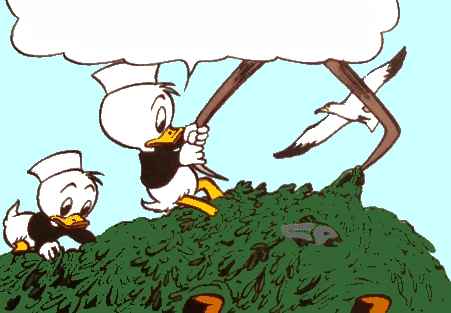
Donald Duck and his nephews Huey, Dewey, and Louie have hired a boat in order to go fishing for seaweed (kelp) that can be sold to the iodine industry. The meager harvesting takes place somewhere in the ocean waters around the islands of the West Indies. The Ducks deliver a cargo of seaweed at the nearest port where they learn of an upcoming event in which an unknown, local boy-child is expected to be kidnapped and never be seen again. This has happened like clockwork in 50 year intervals for almost 400 years, and tonight is the night...

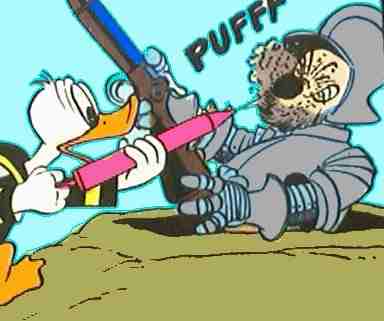
The Ducks sail off searching for more seaweed and arrive at a promising little island lagoon with an abundance of kelp, but it takes some ingenuity to get to it. After having been stranded on the island's coral reef they discover an old Spanish galleon. But the barren reef is inhabited - by a troublesome old man in ancient armour - and he kidnaps Dewey!

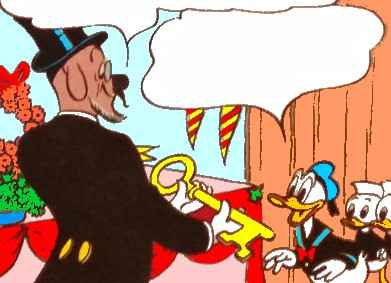
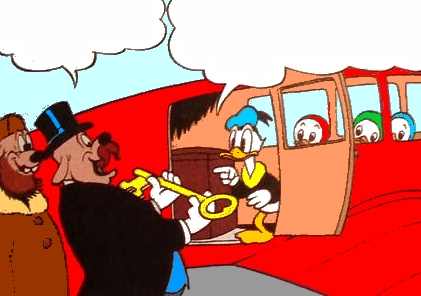
As it turns out, the old man was the last one to be kidnapped half a century ago, and he is 'only' carrying out orders he has received about guarding a chest of gold for the British crown. Donald releases him from his duties, and receives the Key to the City in gratitude from a relieved mayor for saving future generations of male children.


COMMENTS

This long adventure story is a good example of Barks' almost uncanny abilitiy to get many more ideas than needed:
I can remember the first idea I had on that was just trying to figure out something Donald could do. I thought of him sailing boats and came up with a potential 10 pages of gathering seaweed, and selling this kelp, which would give me a lot of gags with boats. I think of a scene, a locale, and think, 'Well, I feel in the mood to draw boats, and the ocean, and so on,' and that would cause me to start working on that particular type of story.
As I developed more and more things with the story, I think it's quite possible that that 'Ghost of the Grotto' was brought in as a menace. There is so much in that, I couldn't have thought of it in a whole bucketful of writing at once. It had to come out one thing after another.

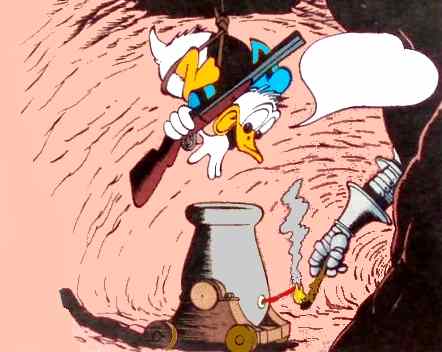
By chance, the Ducks stumble upon the old guardsman in shining armour who has, for many years, been defending an ancient treasure situated deep inside a grotto. The nearby villagers perceive him as a ghost, but the situation is actually much more serious, because the old man - as well as many others before him - were kidnapped at 50 year intervals as young village boys in order to portray a British sailor from the time of Francis Drake. This means that children - brainwashed ones to boot - are in fact the story's most crucial element, although we never get to see one!!!


The kidnapping guard is indeed a cruel and ruthless man indoctrinated to defend a stronghold that has no meaning anymore, until he acknowledges the errors of his ways due to Donald's determined intervention.
In a way this somewhat psychopathic, overly dutiful villain can be perceived as Barks' first sympathetic villain in a long line of varied scoundrels.

Barks skipped lightly over the old guard's past, as it would have been hard to explain anyway. This is why we are never informed of his name and which family he was abducted from 50 years earlier. At least some of the descendants must still be alive, meaning that he might still have relatives in the village area.

In numerous interviews Barks mentioned different stories as his favourites through the years. It is plausible that they were just mentioned, because they connected with subjects in the interviews, and that Barks just mentioned them to reinforce and illustrate a certain point he was making. One of his often mentioned stories was this one.


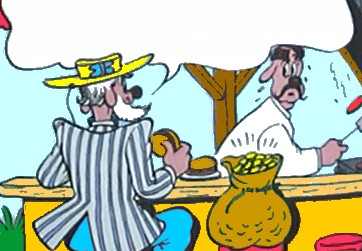
The end scene at Tony's Burger Palace. After having eaten only fish for half a century, the former treasure guard has an order: Another of ye hamburgers, scullery knave! They taste mighty good...
During the story he has indeed been talking medieval English using an assortment of quaint terms such as Yon Varlets, I must sally Forth, Howbeit, and Odds Bodkins.

Barks incorporated two famous, historical figures in the story:
Elizabeth I (1533-1603) was Queen of England from 1558 and known as The Virgin Queen, because she never married. During her reign (and in the story as well) she was affectionately called Good Queen Bess.
Francis Drake (1542-1596) was a British sea captain on the famous vessel The Golden Hind. He is especially renowned for attacking Spanish ships laden with conquered silver on their way back from the Americas to Spain.


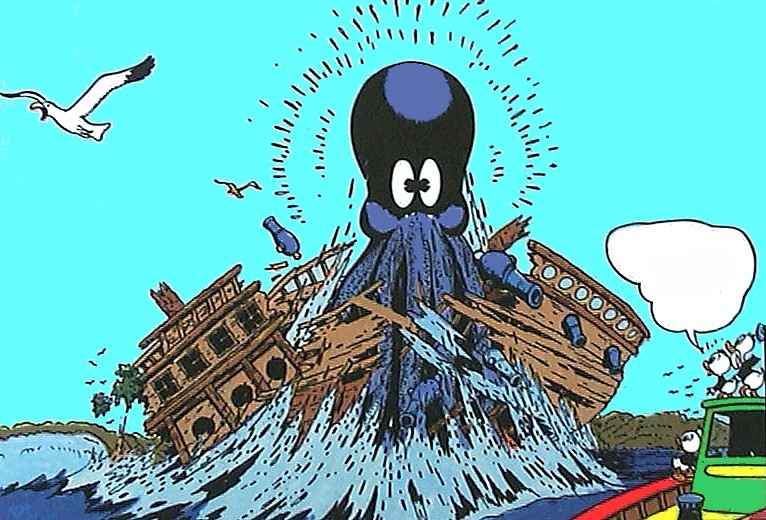
Barks' first halfpage splash of many memorable ones was a powerful visual rendering of a  giant peppered-up octopus:
I allowed myself one moment of spectacle, a release of all the stored-up energy I had going. Huey routs the octopus with a dose of chili powder, and the terrified beast comes bursting through the wreckage of the galleon, sending timbers, cannons, and seagulls flying.
It just seemed to me that I needed one big panel to explode in people's faces. I would draw it with as much detail as I could. I had that yen to draw every once in a while, a feeling that I was cramped into these little bits of panels. I got awfully tired of that small stuff and yearned to draw something big!

The Ducks are not exactly in awe of the menacing guard. They refer to him as Old Tin Pants, Iron-plated Crook, Cast-iron Gopher, Jingle Joints, and Sir Boiler Shirt...


TITBITS

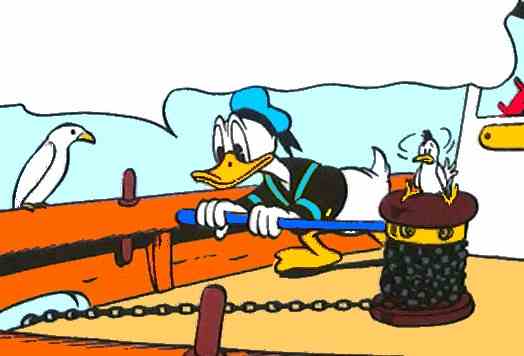
Barks liked to add inconspicuous slapstick scenes that had little connection to the goings-on. In the story he added this comical rendering of a dizzy bird sitting on the capstan.

In April 1947 Barks delivered two adventure stories to his publisher. First Adventure Down Under (25 pages) and then 11 days later Ghost of the Grotto (26 pages). They were published in the same issue (FC0159), but Western probably deemed the latter more interesting as it took center stage in the issue.


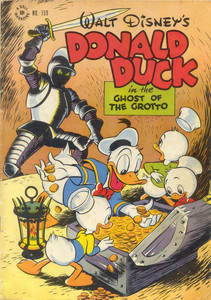
FC0159 - August 1947

During the first years of comic book making Barks did not contribute front covers. The associated one was made by one of the editors at Western Publishing, Carl Buettner.


FC0062 Frozen Gold

In both stories Donald is presented with an identical honourary Key to the City by the local mayor in the end. This was certainly not the only time Barks recycled panels.

Barks' wife Garé's favourite story was, by her own admission, the Grotto tale, because, as she put it: 'It's got pathos'. Her great contribution to her husband's artwork was inking of letters and backgrounds.

Barks put a lot of work into the story, and he perceived it as one of his best. In a popularity listing involving publishers around the world, it came in as #8 among the many adventures (see more HERE).

There can be little doubt that Barks enjoyed inventing titles of two or three main words that started with the same letter or sound. Ghost of the Grotto is one of many examples (see more HERE).
Barks also invented new character names using the same formula; just think of inventor Gyro Gearloose, cousin Gladstone Gander, the villainous Beagle Boys, and Duckburg's founder Cornelius Coot.

In the story Donald gets help from a mouse called Montmorency. The name is rather special, but Barks also used it (along with many other odd names) when employed at The Calgary EyeOpener.
When he later worked on the short cartoon Donald Duck Gets Drafted at the Walt Disney Studios he added another rarity, namely Fauntleroy, that has since been Donald Duck's middle name.


PAINTING

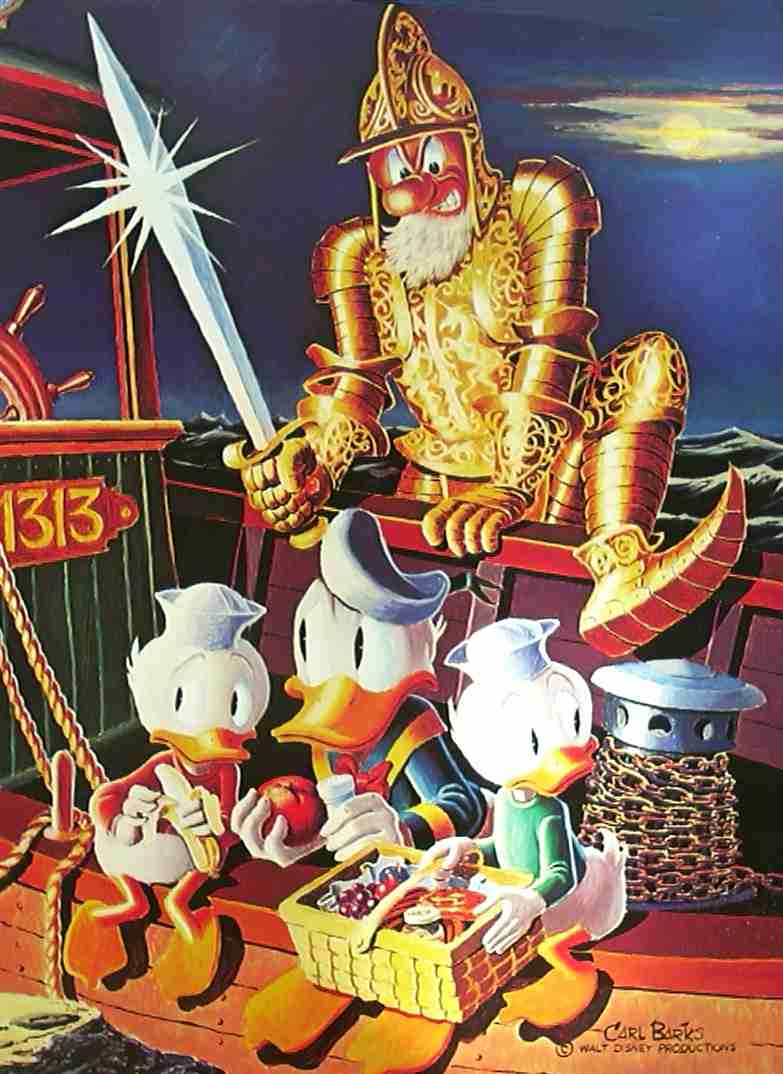
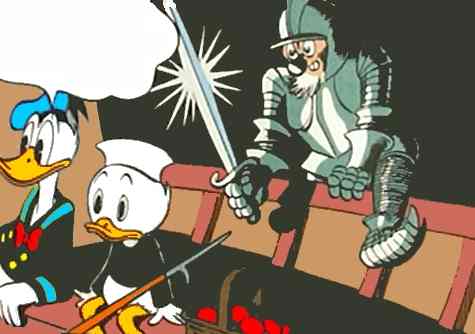
28 years after the story premiered Barks made this oil painting with a rendering of one of the strong panel scenes, when the guard boards the Ducks' vessel.
It was coded and titled 20-75 Menace from the Grotto. It is in the size 12x16" (305x410mms), and it was sold for 1,500 dollars.

Compared to the panel Barks could add more detail such as elaborate armour decorations, a capstan (remember the dizzy bird?), an assortment of fruit, and background.
He even added one nephew (present are Huey (red shirt) and Louie (green shirt) thus correctly omitting Dewey (blue shirt) who has been kidnapped.
Also notice the guard's more human features; a real nose and 5 fingers on each hand.


20-75 Menace from the Grotto

The triggering panel


 http://www.cbarks.dk/THEGROTTOSTORY.htm

  Date 2018-07-10