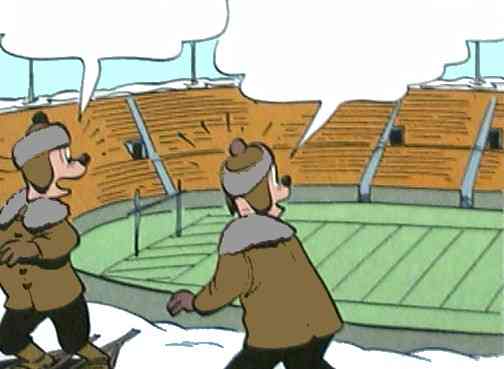
The vast majority of Carl Barks' Disney comic book stories are rather timeless in the sense that they do not refer to specific years or named events, but there are a few exceptions. One of them took place in WDCS188 'Olympic Tryouts' that was published in 1956, in which Barks took up one of that year's exciting events, namely the worldwide sports craze known as the Olympic Summer Games. This is the story.


THE STORY


WDCS188 'Olympic Tryouts'
- 1956

Short synopsis:
Due to a massive incapacitation of the stronger athletes, Donald Duck is chosen to represent Duckburg in the upcoming Olympic Games.

A few comments:
 

In 1955 Barks was inspired by the upcoming Olympic Summer Games to be held in Melbourne, Australia, the next year. This triggered the sports story in which Donald competed in Duckburg Stadium in diverse athletic events for a place at the real games. In 1964 - before the games in Tokyo, Japan - Barks had yet another Olympic story published, WDCS286 The Olympian Torch Bearer, in which he set the scene outside the stadium areas by letting Donald carry the traditional Olympian torch from Goosetown to Duckburg.


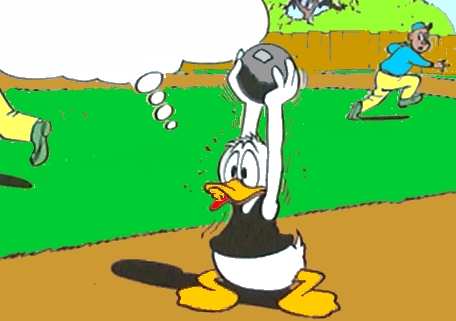
In the last few decades the sound body of man has become more and more the center of focus. Training facilities, workout programs, jogging, and physical health awareness in general are some of the indisputable signs. And had Donald learned the correct lifting technique, he might have had a chance of succeeding at the Olympic tryouts...


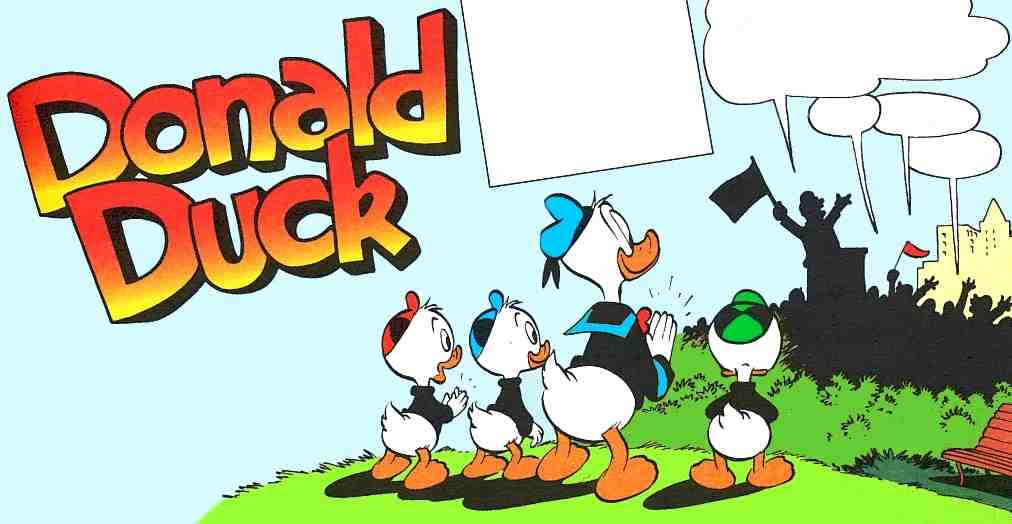
Surprisingly, Donald proves to be quite versatile in the required sport events, but, less surprisingly, he is not very good at any of them! But as the primary sportsmen drop out, he bravely takes up the gauntlets despite of his oh-so visible lack of stature and skills...


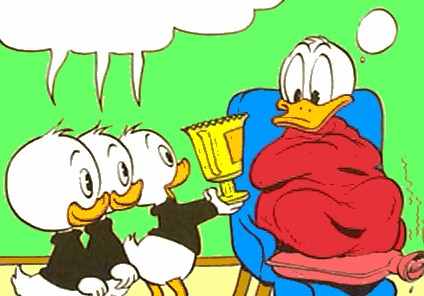
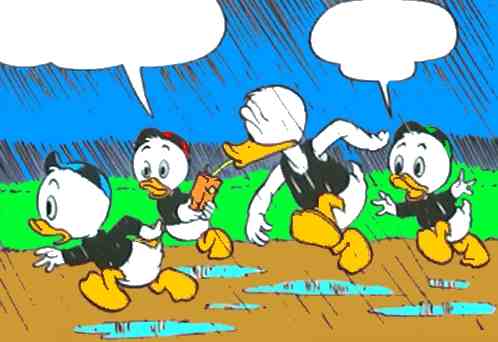
In this story Donald was, once again, in grave difficulties, this time at Duckburg's stadium where he tried to qualify for the Olympic Games. After having failed miserably in all events the nephews presented him with a cup with the inscription It is not to Win, but to Try that is Important!, to which Donald smilingly responds: Doggone! You kids make me feel like I'm really somebody!


Barks was never a practitioner of any sport and when reading the story it becomes obvious that his knowledge of sports was very limited, and he was not on familiar turf when drawing the athletic events Donald has to go through. Therefore it may seem somewhat unusual that he would choose specific sports events of the Olympic Games as the underlying theme of this story. A plausible explanation might be that he was encouraged to make an Olympics story from his publisher.
The very fact that Barks did not know much about the general setup and the events can easily be deducted from several major mistakes (see more later).


At some point in his professional career, any artist is tempted to put in a reference or a caricature of himself in his work and Barks was no exception. They served as in-jokes, because nobody knew him at the time (see more HERE)!
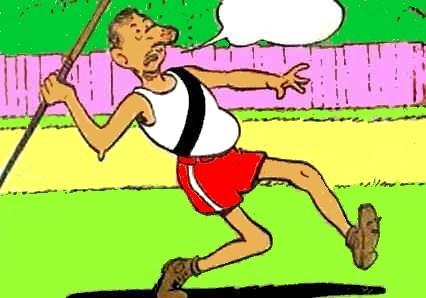
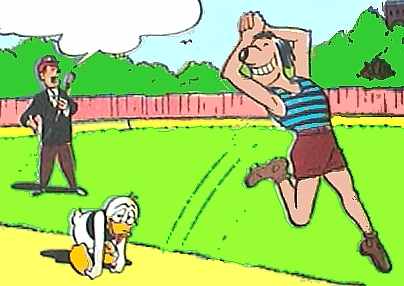
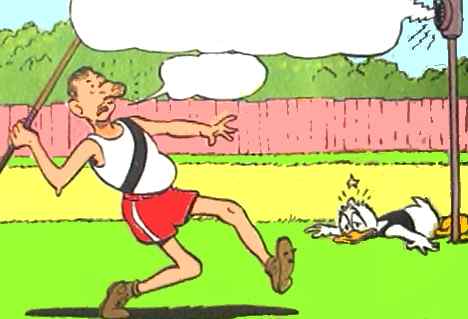
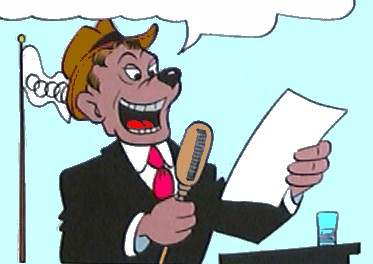
Fans have searched his stories for that sort of self-portrait, but the most convincing example came in this story, in which Barks drew himself as the hay-fever stricken javelin thrower Fulldrip Pulpbugle, and he even has a speaking part. Barks is easy to recognize with his cartoony sized nose, and he also portrays the athlete as a man suffering from severe hayfever, an infirmity that Barks himself struggled with most of his life!


THE EVENTS

The storyline incorporates 6 of the many events known from the Olympics, and they are all from a stadium's track and field repertoire. Here is a brief description mentioned in chronological order:


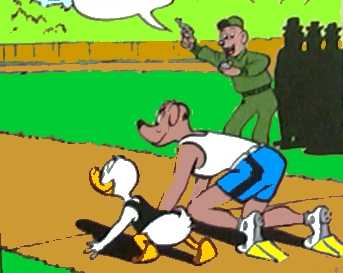
100 meter dash: The initial competitor is the sprinter Ramjet Rocketflash, who is, however, held back by his wife (or mother) thus ensuring that he does not leave the home to avoid feeding the cats. Donald runs alone but is not able to break the finish line, wherefore he is excluded.


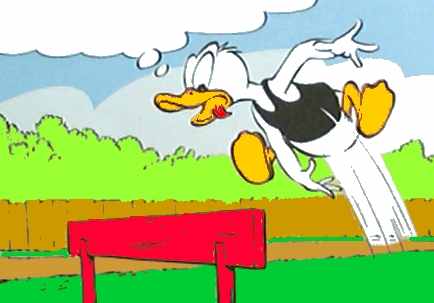
Low hurdles: The initial competitor is the native Indian jumper Chief Bounding Rabbit, who, at the starting line is informed of yet another 3 oil wells just discovered on his land. He immediately takes off to deal with them. Donald runs alone, but is not able to clear the first hurdle, and he is out.


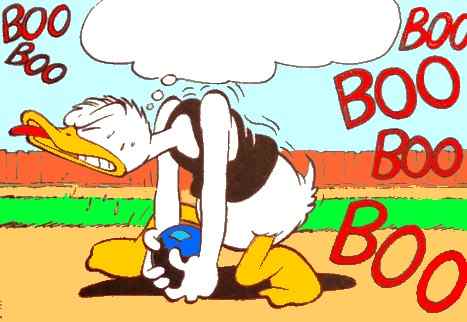
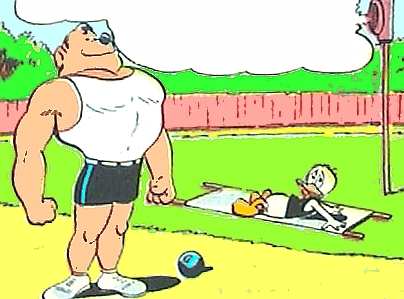
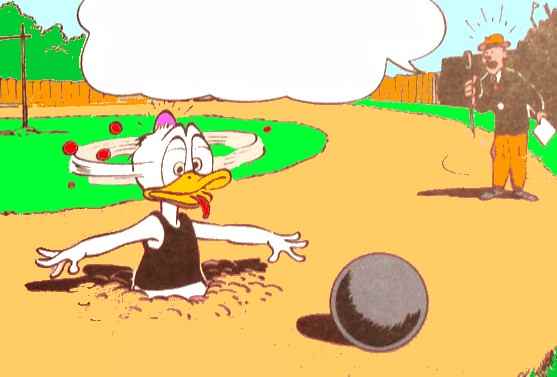
Shot-put: The initial competitor is the powerhouse Trestleman Truckhorse, but he is held back by his mother (or schoolteacher), because he is way behind with his ABC. Donald takes over, but the iron ball is far too heavy for him to throw. When it is over his head he manages to ram himself into the ground like a peg, thus making sure that Duckburg will not compete in that event either.


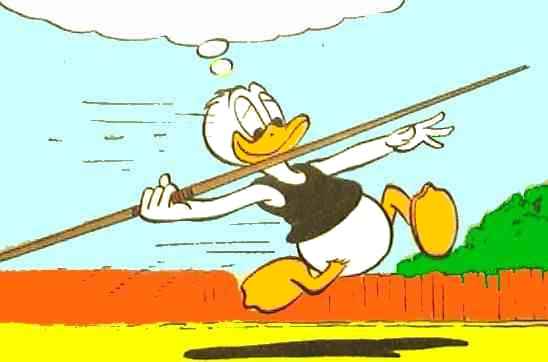
Javelin throw: The initial competitor is the javelin thrower Fulldrip Pulpbugle, who is suddenly stricken with hayfever caused by dandelions, so he has to a-choo his way out of the stadium. Donald picks up the javelin preparing for an easy throw, but he also catches hayfever at the crucial moment resulting in the javelin boring through the ties of the present judges, and he is disqualified.


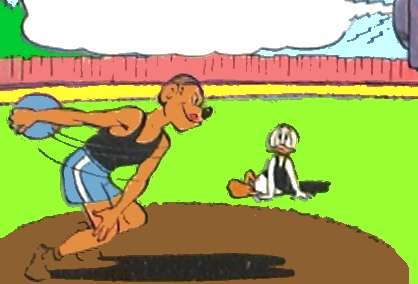
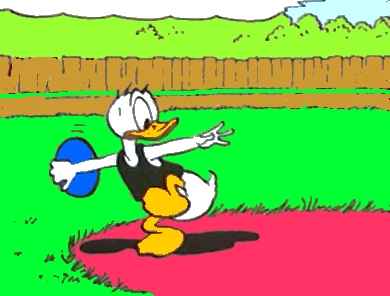
Discus throw: The initial competitor is the discus star Whirlman Dervish, who manages to sprain a vertebra while twirling in his first attempt. Donald picks up the light discus but spins so fast and uncontrolled that he wrecks equipment and injures officials, thus making sure that Duckburg will not send a representative to that event, either.


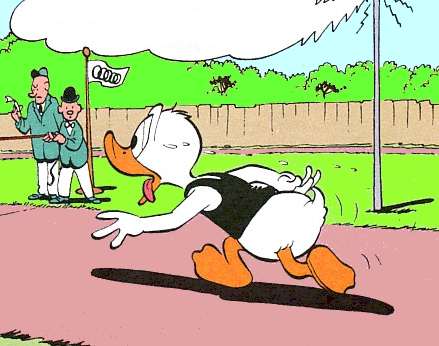
1500 meter run: Donald is all alone in this event (any possible competitors are not mentioned), and anyway the spectators and the officials have gone home in despair - with the exception of the official who fires his starter's gun ('the gun barks' as Barks injokingly puts it!). Against all odds Donald manages to finish the race in a poor time but as there are no official witnesses his 'achievement' can not be accepted.


THE TITBITS


In the three running heats Donald moves left on the track instead of right. Also, the shot-put takes place in the middle of the track! Any reader will undoubtedly perceive these things to be incorrect, although one shall have to make allowances for the artist's right to let the events unfold as he sees fit. Furthermore, Fulldrip Pulpbugle's shoulder ribbon changes place...


In this sports story we are presented with Barks' rendering of the Olympic flag - 5 circles in a linked row. The correct image consists of 3 interlocking circles accompanied by 2 circles in the next row. Barks continued to draw the wrong symbol until the last time it is shown; then the image is suddenly correct - but on a triangular flag!


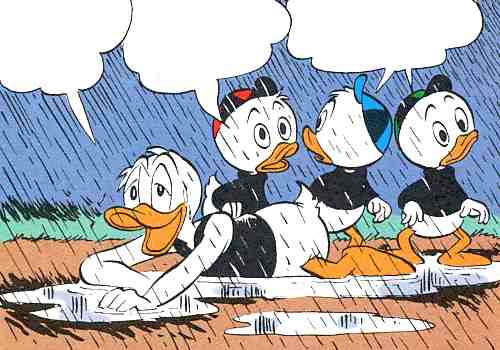
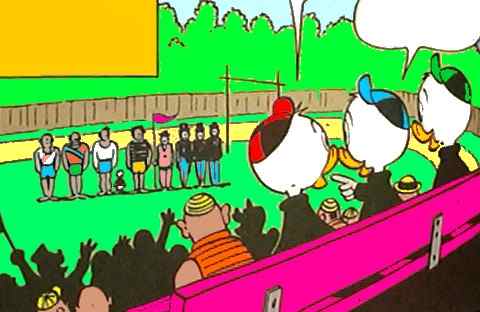
It would seem that Barks miscalculated the space available when he drew this panel, because in order to get all three nephews in the picture he had to squeeze the farmost nephew's head. Also, we know from other stories that Donald is 3 feet tall, thus making the shown athletes much too tall.


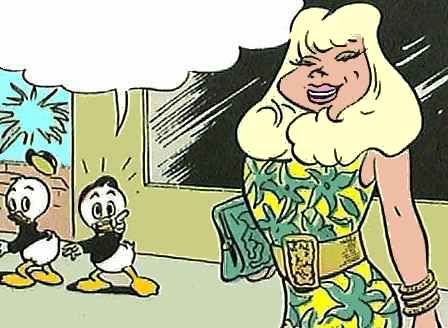
In other stories Barks used a number of human characters with inspired and inventive names. Here are some unforgettable examples from WDCS245 Sitting High: Actress Jayne Girlsfield, Actor Snarlin Grando, Politician Gasmore Gravytrain, TV-star Tallin de Saddle.


It would seem that Duckburg has a number of sports facilities. Here are some examples: Bowling alley (FC1055 The TV Babysitter), wrestling arena (SF2 Jungle Hi-jinks), boxing hall (WDCS282 Bubbleweight Champ), racing tracks (WDCS166 'Midget Racers' and U$66 The Heedless Horseman), football stadiums (MMA September Scribbage and U$41 Snow Duster), and two(!) Olympic athletics stadiums (WDCS188 'Olympic Tryouts' and WDCS286 The Olympian Torch Bearer). Plus at least 4 golf courses...


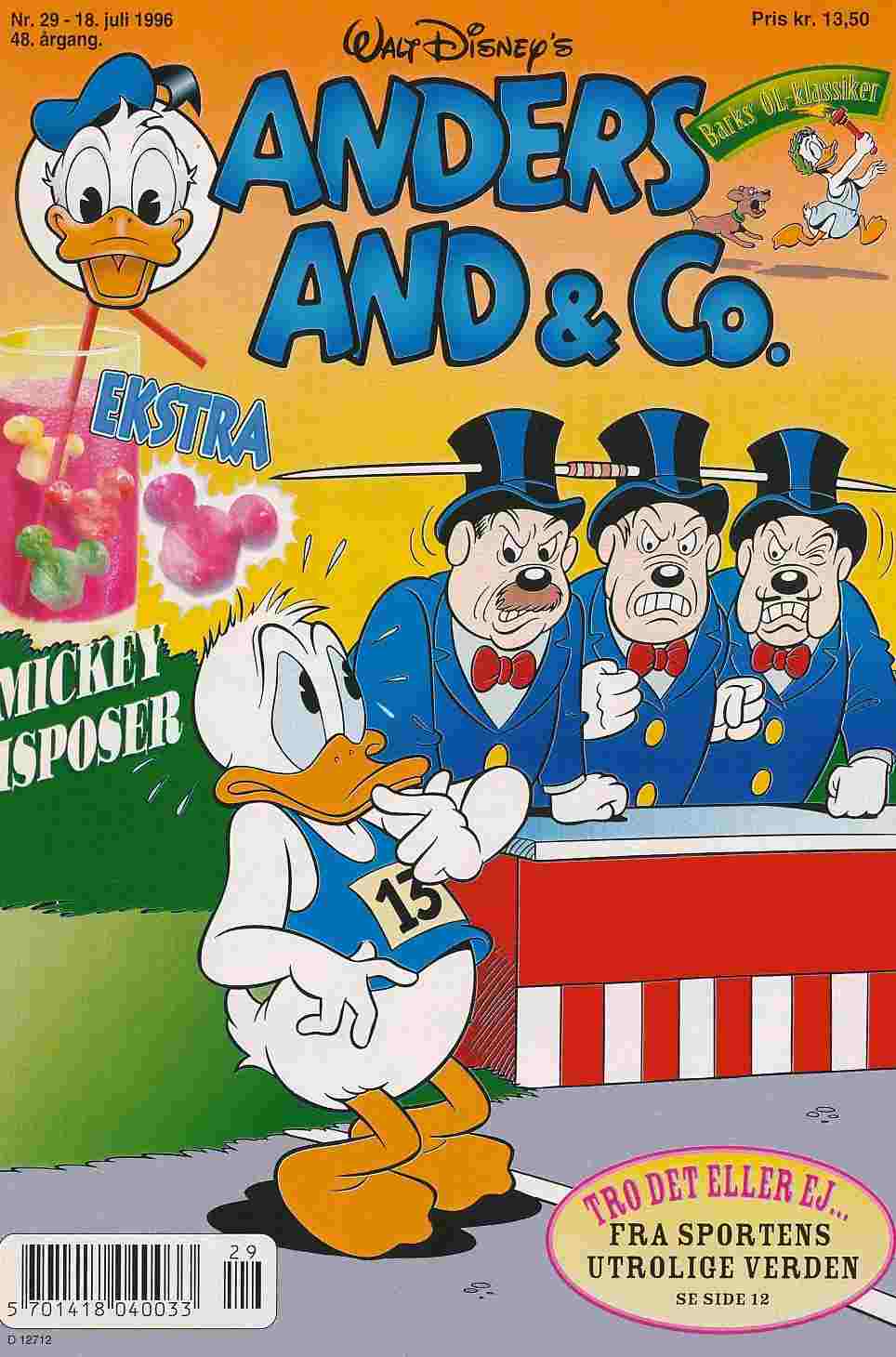
Occasionally, artists have used elements from Barks' stories for front covers. This example comes from the Danish Donald Duck magazine #29, 1996.


THE PAYMENT

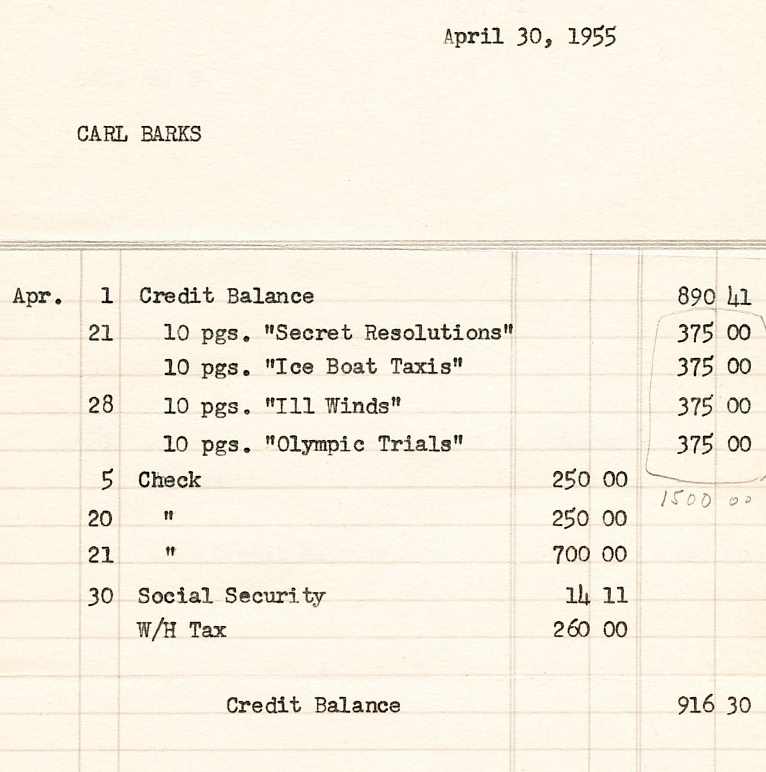
In those years Barks and his wife Garé would oftentimes drive their car to the publisher's office to deliver the new stories by hand in order to make sure that no harm would come to them. Western Publishing would then register the material and issue payslips shortly after. The above is a typical example, in which Western booked more stories by date of receipt (either from Barks personally or by mail). The actual delivery dates were the 12th and the 19th, respectively.
As you can see from the payslip Barks was credited for a total of 4 stories at 375 dollars each, which was the going rate. At the time Western had, of course, not planned the issue numberings but with the help of Western's work titles it takes little effort to sleuth out that the stories were published from the beginning of the following year in issue nos. 185, 186, 187, and 188.
As for the other information and general 'build up' of the payslips you can see more HERE.


 http://www.cbarks.dk/THEOLYMPICSTORY.htm

  Date 2018-02-05