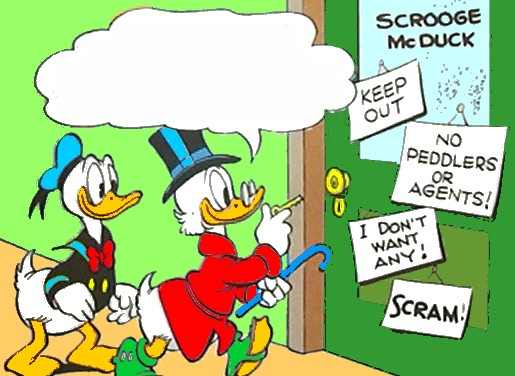
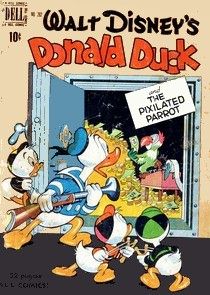
In the beginning of his Disney comic book career Carl Barks made his long adventure stories both engrossing and exciting, and we are immediately swept along by his unique storytelling abilities. The long adventures were the perfect medium for him to dig into far more faceted and detailed events than it was possible to obtain in the 10-page stories, that were usually concentrating on fast paced, hilarious fun. Barks would eventually acknowledge that he needed some measure of funny incidents in his long and occasionally complicated adventures and began with a humorous tale typical of his shorter stories. This story construction was first used in FC0282 The Pixilated Parrot from 1950. This is the story.
|
A SHORT SYNOPSIS |
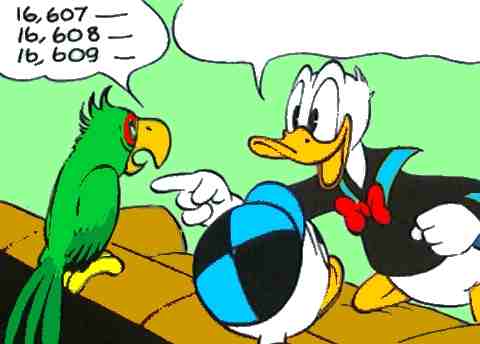
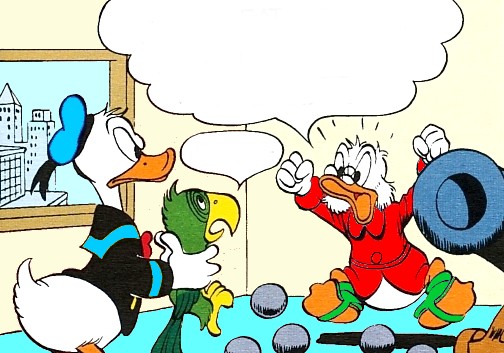
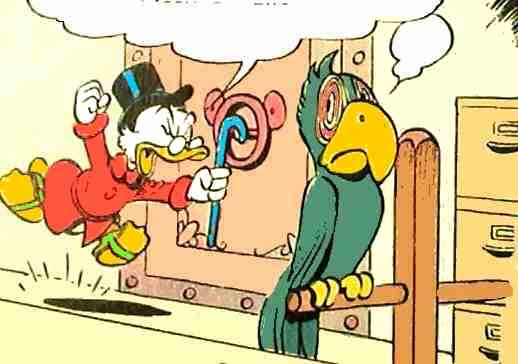
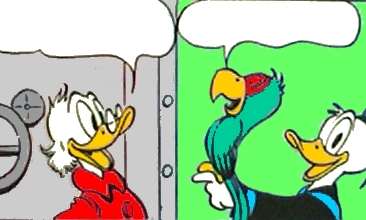
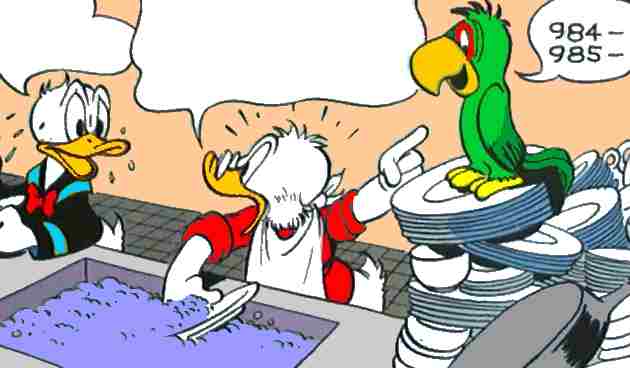
FC0282 The Pixilated Parrot - 22-pager - 1950 Donald
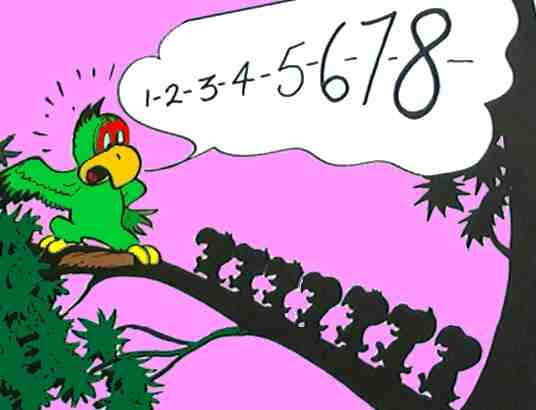
Duck and the nephews have bought a laid-back, good-natured,
talking parrot, who is talkative in a most unusual way; it
quietly spends all of its time counting anything in sight! Donald
gives the bird to Scrooge McDuck on his birthday, so it can count
his money for him. The story establishes several new main ideas and inventions that Barks would start using officially in the near future. See more later. |
|
A FEW COMMENTS |
|
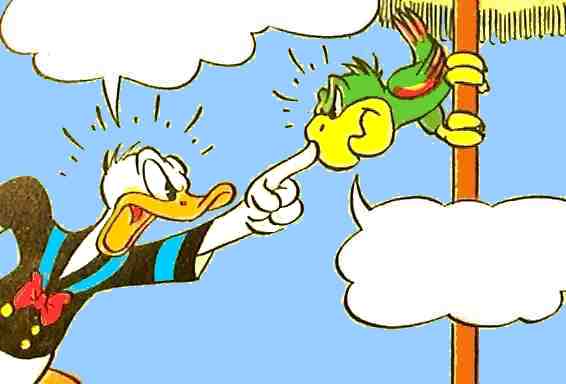
The parrot is a male but is
nevertheless
called Polly by the nephews. The name Polly is usually associated
with female gender, but it can actually be traced to the early
1600s, in which the British playwright Ben Johnson used it in the
comic
play Volpone for a character named Sir Politic Would-Be, or Pol for
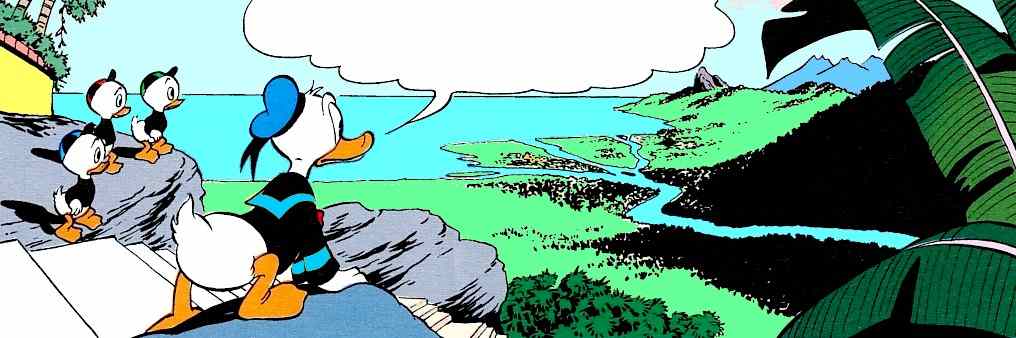
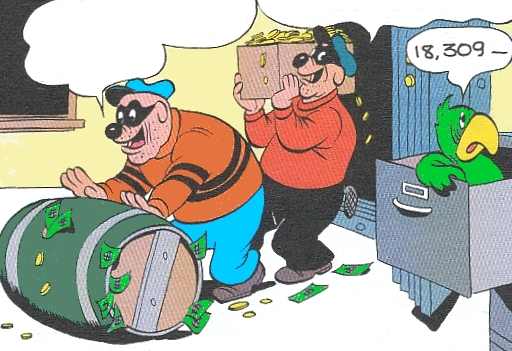
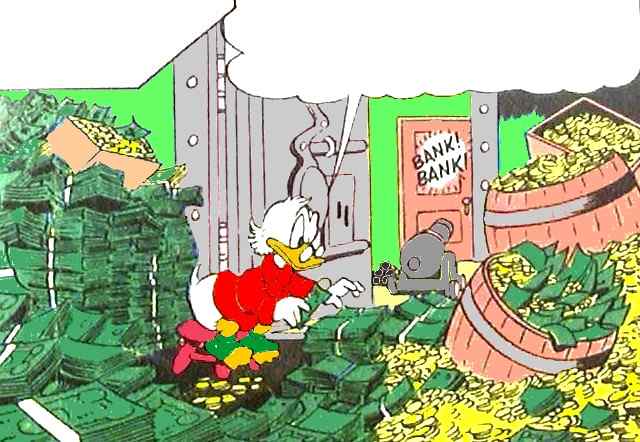
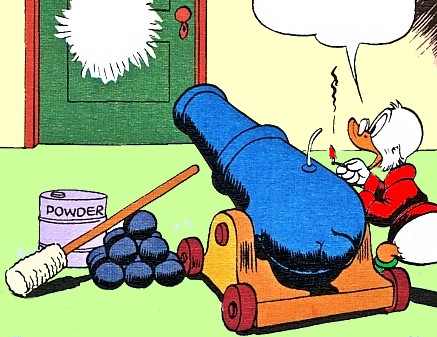
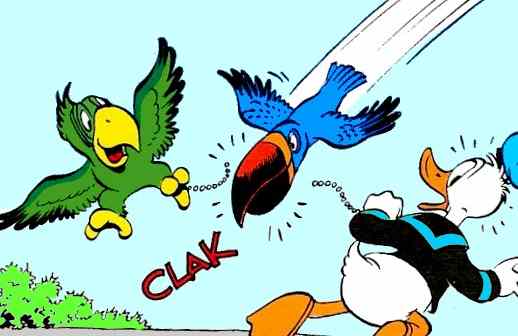
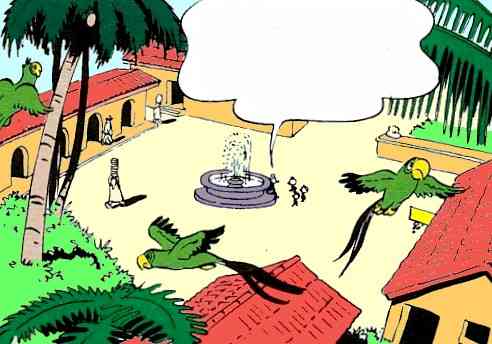
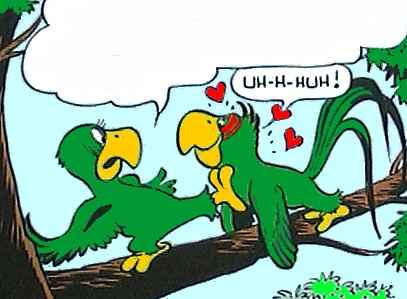
short. Polly must have an astounding photographic memory combined with distinct X-ray abilities. At least, he counts bananas that he has seen in a ship's cargo rooms weeks before. When the nephews buy him he is actually 3 days behind with his counting... Barks introduced some sort of chaotic love story, when Polly was eagerly chasing a sexy female parrot with a clear wolfish intent of getting to know her better! Presumably, the heated scene must have been close to the censor's hatchet. Barks used a similar beginning to the story as he had done in an earlier one. In WDCS065 'Joe From Singapore' the nephews were also browsing the harbour, and they were also handed a parrot from a sailor. At the start of the parrot story a boat carries bananas from Costa Rica in Central America, which is still today a major exporter of the curved fruit. The last half of the story takes place in the fictional country of Tropicania that is supposedly also situated in Central America. Scrooge is using his cannon as a guard dog pointing at possible burglars that might turn up in his office. Besides gunpowder and an assortment of cannonballs we also see - for the first and only time - the necessary ramrod used to push the ingredients to the bottom of the gun barrel. In a rage Scrooge happens to knock down the pyramid of cannon balls, sending them all over the office floor, but immediately after they are stacked nicely again... The stories have had several locations and means for storing Scrooge's money before and after the Money Bin appeared. Examples: FC0386 Only a Poor Old Man (high-rise building), FC0495 'The Water Tank Bin' (movable Money Bin), WDCS124 'New Management' (money barn #68), WDCS126 'The Money Bin Crib' (corn container), and WDCS130 'The Rare Coin' (scanty office). In the parrot story Scrooge keeps his money in a 'gold-plated office building'. The story was by no means the only time Scrooge needed to remember the combination of his safe. Other examples: In DBP 'The Impenetrable Money Bin' he had it tattooed on his chest, in U$09 The Lemming with the Locket it was written on a piece of paper, and in U$60 The Phantom of Notre Duck it was played as a melody on a flute!
You
will find a telling example of Scrooge's stinginess and boastfulness
in this proclamation from the story: When it dawns on Scrooge that the parrot
eats crackers for 10 cents a box he yells to Donald: Parrots eat crackers, and crackers
cost money! What do you think I am - a billionaire?
|
|
THE PERPLEXING TITLE |
Barks' use of the term Pixilated in the story's
title does come across
as rather odd nowadays where the term mostly means Intoxicated, and this
was of course never his meaning. Another definition of the term
is Eccentric which comes much nearer his intention. But Barks
actually used the term in the meaning Crazed (or even Mentally
Disordered) as it was used in those days. Long after Barks titled his story the term has had a revival; spelled Pixilated (or Pixelated) it refers to groups of pixels used for resolutions in modern technology such as computers and cameras. |
|
POSSIBLE PRESTUDIES |
|||
|
The story may be viewed as some sort of a forerunner, in which Barks developed new ideas and invented new gadgets that would all be refined and incorporated in many later stories. Here are some examples: |
|||
|
|
A SMALL CHRONOLOGICAL GALLERY |
|||||||||||||||
|
|
TITBITS |
|||
|
|
EXTRA |
||
|
Earlier Barks had made 3 more stories with parrots in leading roles: |
||
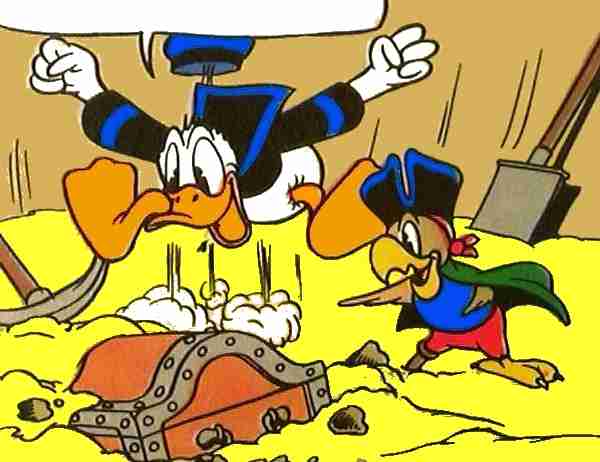 FC0009 Pirate Gold - 1942 Synopsis: The parrot Yellow Beak is hiding from Black Pete in Donald's seashore tavern. Out of gratitude he leads the way to an old buried treasure. |
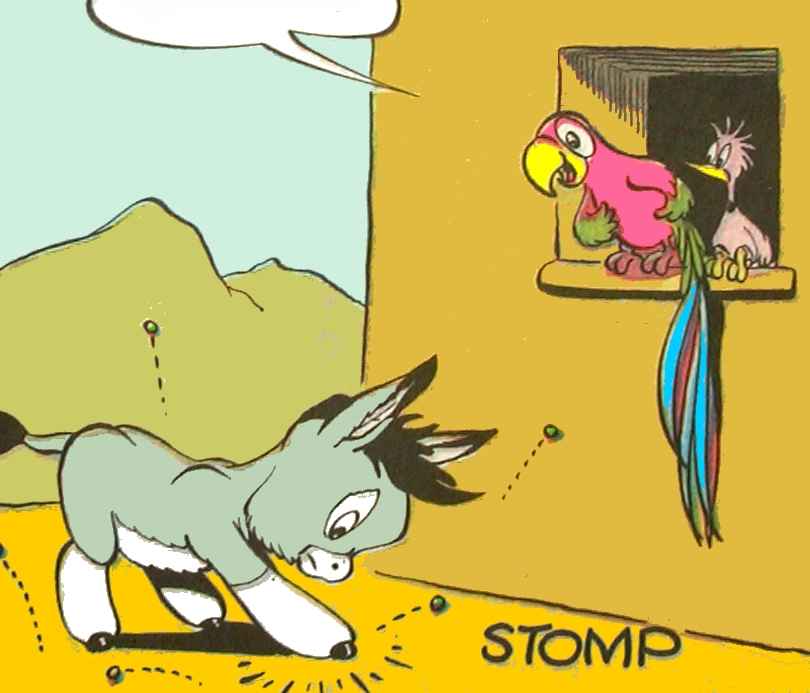 OG10 'El Macaw the Trickster' - 1944 Synopsis: Benny Burro is out looking for the most beautiful bird in the world which is supposed to be El Macav, a parrot. Unfortunately, he is also quite troublesome. |
Synopsis: The nephews want a pet but the parrot Joe from Singapore might not be the best choice. Especially because of his rather rude language... |
|
http://www.cbarks.dk/THEPARROTSTORY.htm |
Date 2018-08-10 |