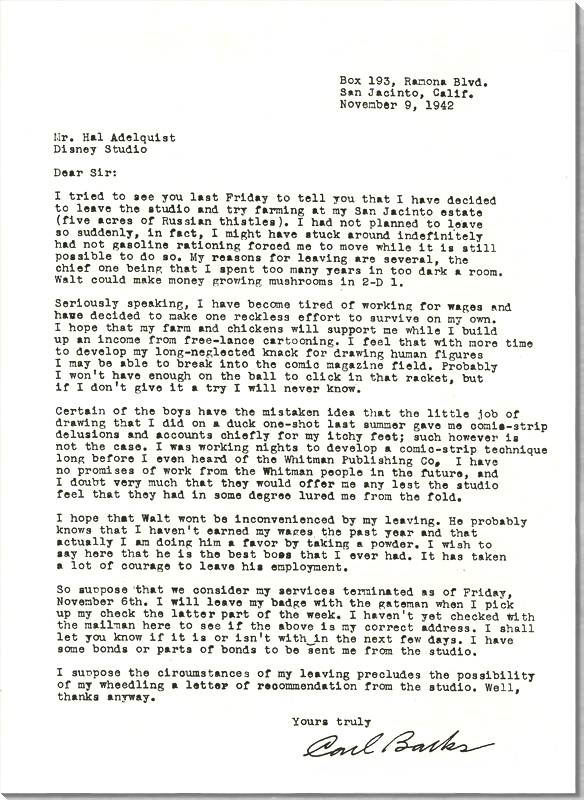
Although he did not know it at the time, Carl Barks wrote his most important letter in November, 1942! It was his letter of resignation from Walt Disney's Studios, where he had worked since 1935. He wanted to have a free hand and earn a living on his own, and this big gamble turned out to be both a lifelong and prosperous decision. If Barks had not taken the very courageous plunge (the war was on, jobs were scarce, and he left a secure job) the world probably never would have heard of Barks' name, but from then on he slowly walked into the Disney duck universe's Hall of Fame. Barks made a stunning career for himself from which he - and his countless millions of fans!!! - have benefitted greatly. The letter was indeed a turning point in many people's lives...


Some of Barks' reasons for leaving Disney's:


  WARTIME (see more HERE).

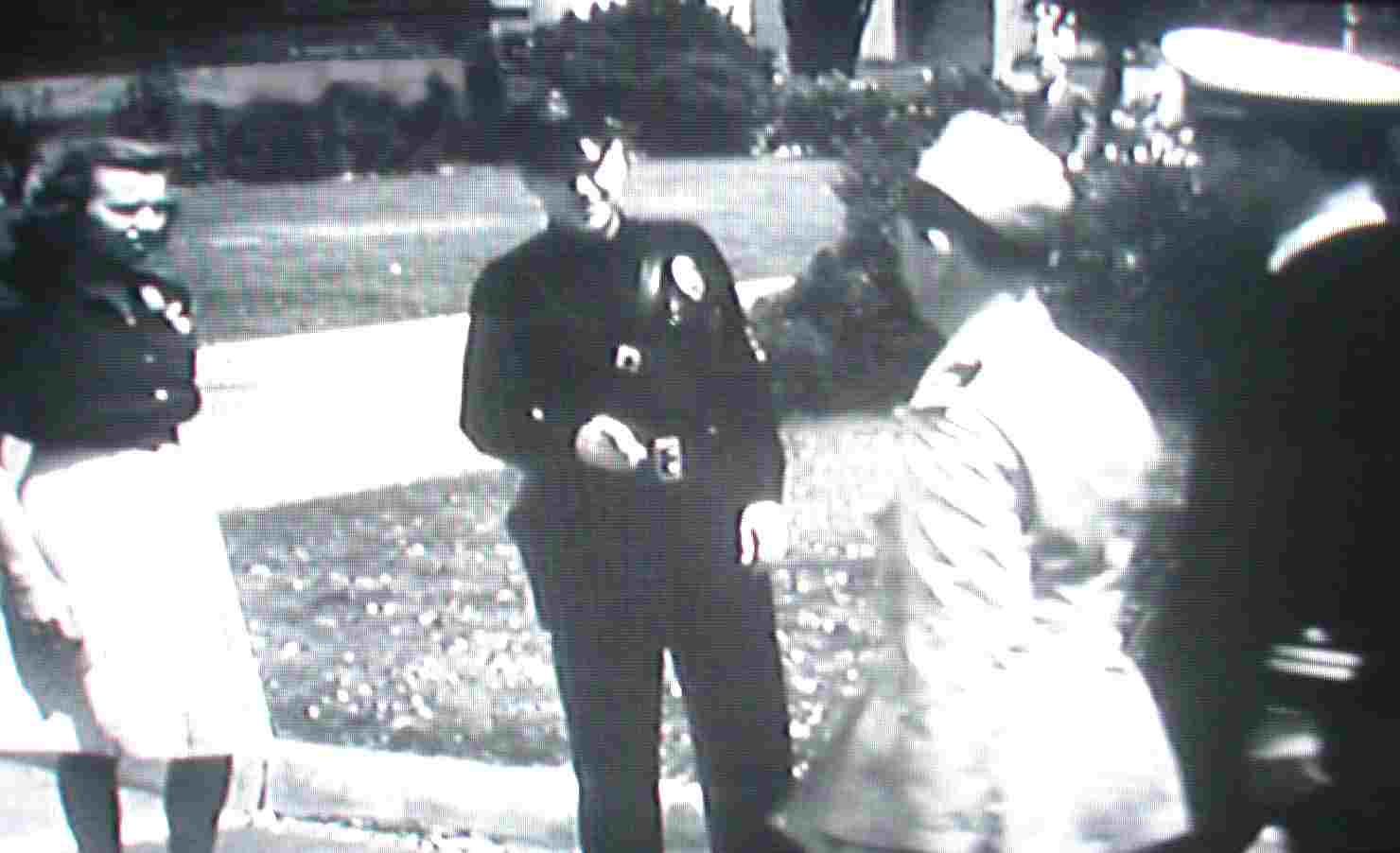
During the first years of World War II, the Disney studios were deeply involved with educational and instructive cartoons. This left no room for the creative mind of Barks. Furthermore, he did not like the strict control the wartime had forced upon the Studios due to the fact that the premises had been taken over by the army when the USA joined the war; some of the facilities became off-limits to the Disney staff, everybody had to wear special ID cards visible at all times, and the control at the main gate was quite rigorous.

PHOTO: Armed, civilian guards provided strict control at the gate and everybody - Disney employees and armed forces alike - had to pass a control point before being admitted in or out of the premises.


  AIR CONDITIONING

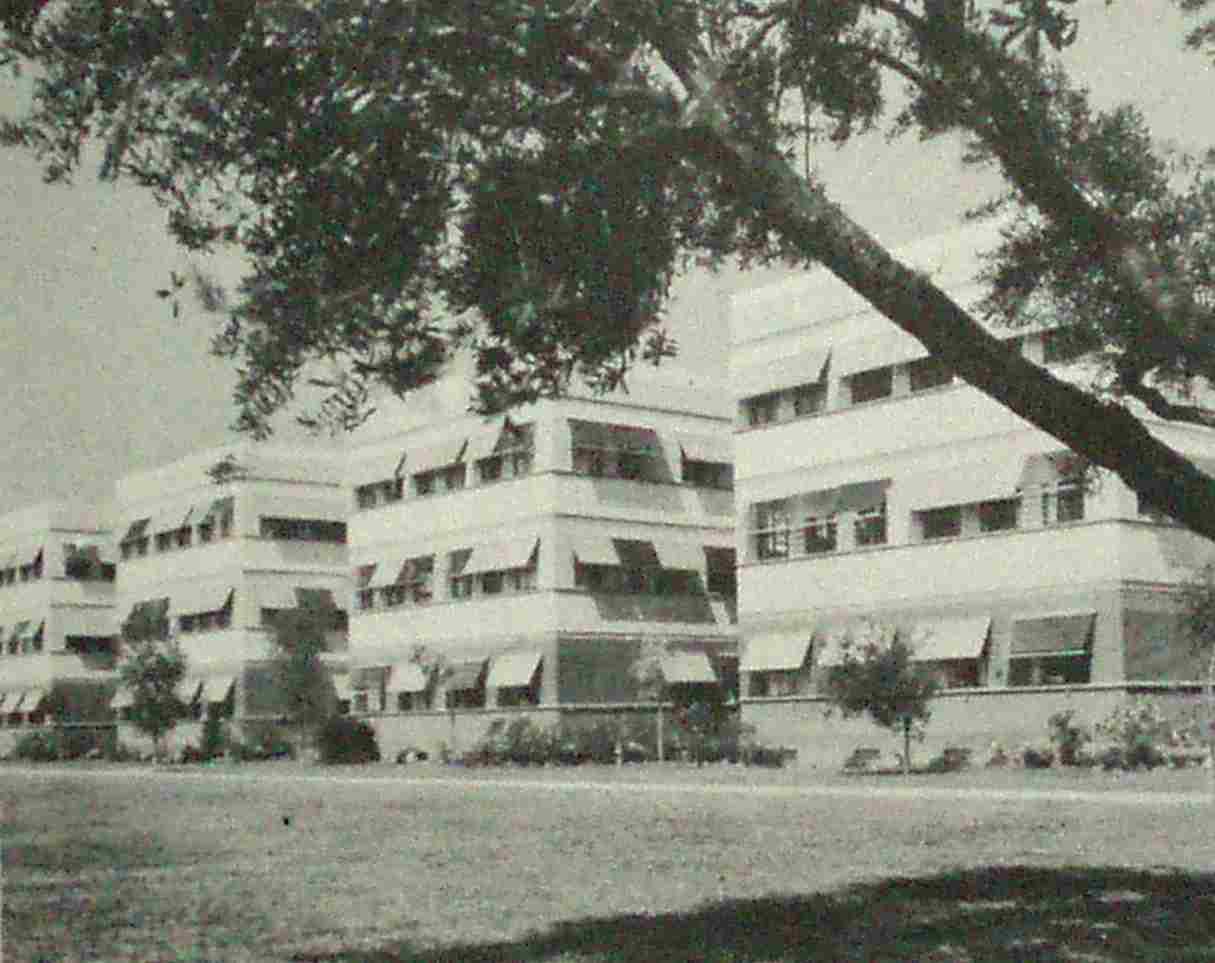
In late December, 1939, to Early January, 1940 the Disney Studios moved to a newly built building complex in Burbank, because the existing ones were fast becoming too small for the steadily increasing number of employees. Barks moved along with the company to the new premises but he was in for a bad surprise. Walt Disney had done everything he could to secure the best possible working conditions in the warm climate; one solution was the extensive use of air conditioning. Barks quickly developed severe problems with his sinuses - he had to undergo a painful operation as a result from it - and the situation became untenable.

PHOTO: The animation buildings in the early 1940s. At the time they were almost futuristic in their exterior appearances (painted in lively pink, creamy, and gray colours) and filled with the latest state-of-the-art machinery - including air conditioning.


  DEAFNESS

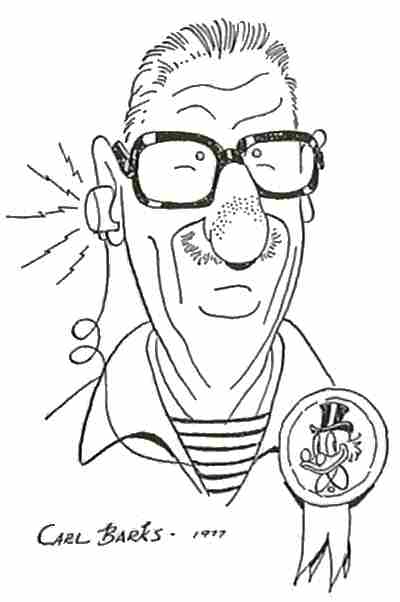
All of his life Barks battled with chronic and increasingly bad hearing, a result of having had measles in his early childhood. In the first half of his life hearing aids were not an option, and Barks had grave difficulties hearing what his colleagues at Disney's said to him. Even worse was when he attended storyboard meetings, where everybody spoke at the same time. This is also why Barks never joined his colleagues to nearby bars after hours; he simply could not participate in the discussions. This fact made him even more determined to be his own master. Later on, when hearing aids became more and more known (and better and better) Barks' hearing improved somewhat.

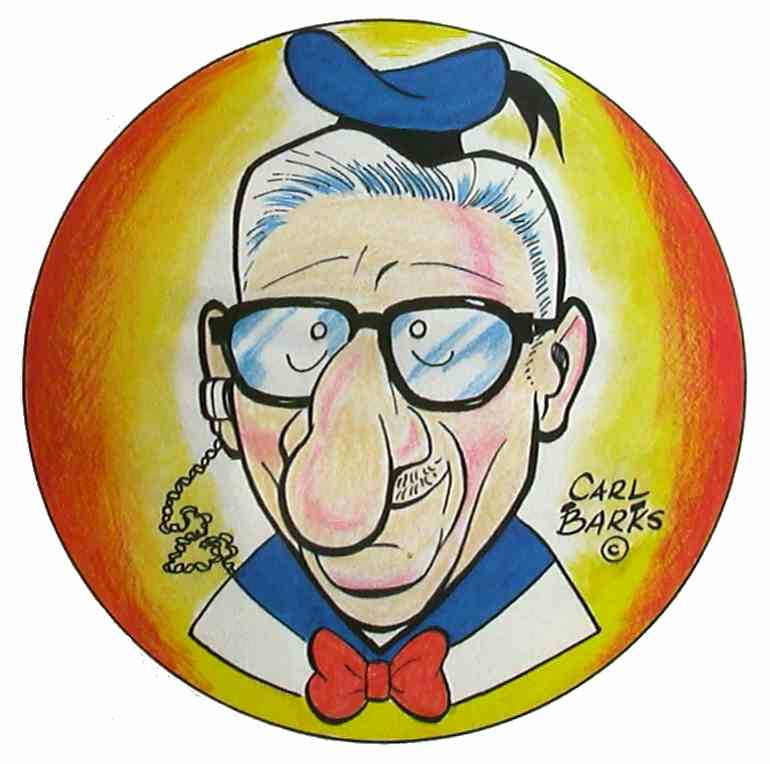
PHOTOS: Barks' bad hearing afflicted other problems on him; the first hearing aids he invested in were wired to a transmitter (about the size of a deck of cards) carried in his shirt pocket, which annoyingly set off the metal detector at every airport he passed through! In his last years he wore some almost invisible hearing aids from Denmark, and they were so efficient that he bought two pairs!


  CHICKEN FARM

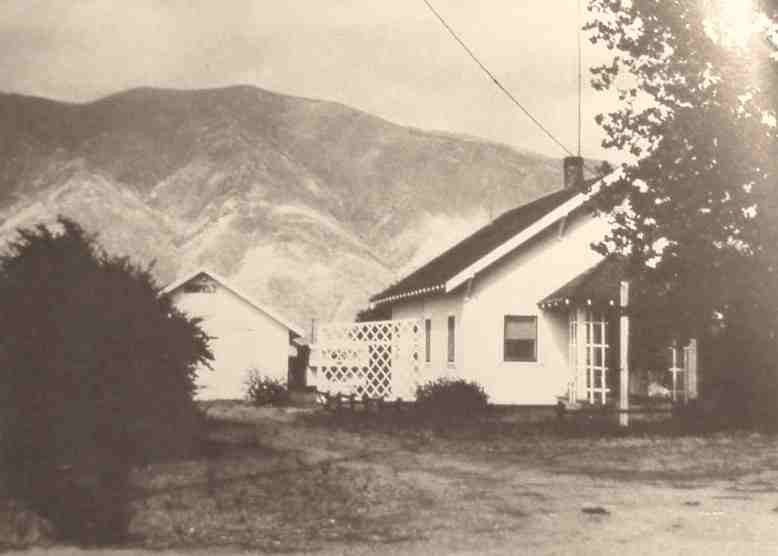
Barks officially moved from Burbank to San Jacinto a few days before his resignation in order to start as a chicken farmer. He had actually bought the place a couple of years earlier, but kept the purchase a secret. In the letter it becomes obvious that he was just about to install himself at the new address, because he was not sure that the mailman had 'found' him yet. Hopefully he did, because Barks typed in a slightly faulty address; the correct one was at Ramona Drive...

PHOTO: The residence in the San Jacinto Valley. Barks would later 'complain' that the breathtaking view of the nearby mountain range from his studio window had cost him hundreds of man hours...


  COMIC BOOK WORK

Up to this point of his life Barks had always been interested in working with comic book drawings. In his childhood years he made countless drawings depicting cartoony and real characters from the newspapers. The years with the girlie magazine The Calgary EyeOpener had brought him invaluable basic graphic skills, and these were honed in the following Disney years, where Barks also learned to dream up, write, condense, and polish a story. All in all, Barks was ready to begin - alongside with his chicken farming - a brand new career in the field of his dreams - comic book work. In the last two months of 1942 he managed to finish no less than two stories (WDCS031 'Victory Garden' and WDCS032 'The Lucky Rabbit's Foot'), and from then on he never looked back...

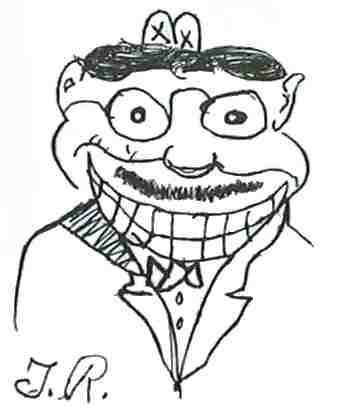
PHOTOS: Barks' surprisingly mature caricature of President Theodore Roosevelt from around 1909, when the youngster was about 8 years old. It is amazing to see how many details young Carl incorporated; from the wavy hair down to the broad smile. The president was commonly known to be accident-prone, which explains the two humorous bumps on his head.


Barks' letter of resignation:


Comments:

It is interesting to see that, apparently, Barks and Disney's had no legal agreement as for giving job termination notice well in advance; Barks wrote his letter on Monday the 9th of November stating that he had, in fact, left Disney's three days before! He must have said his goodbyes to his colleagues and cleared his desk in the firm belief that there would be no complications. Also, the letter makes it clear that Barks was not slamming the door behind him; the first part of the letter is quite humorous, and he has nothing but nice words for his former boss.

The receiver of Barks' letter, Hal Adelquist, had been Personnel Manager for the whole Disney Company since the year before. As so many other employees he had started as an animator (1933) and he grew to be Assistant Director on Snow White and the Seven Dwarfs (1937). After having headed the personnel department for a number of years he was promoted to managing the story department. Later on, Adelquist was assigned as general coordinator for the new Mickey Mouse Club, but in 1956 he was suddenly dismissed by Disney due to personal and professional disagreements.


http://www.cbarks.dk/THERESIGNATION.htm   Date 2007-10-05